.svg)

Blogs
The Telco Profit Reset
Your network, owned or outsourced, is an asset. Your business model is the liability.
Your network, owned or outsourced, is an asset. Your business model is the liability.
March 9, 2026

.svg)
.svg)



Blogs
Your network, owned or outsourced, is an asset. Your business model is the liability.

Chari TVT


THE ONE-LINE THESIS
Telcos will not win by treating all SIMs equally. They will win by treating customers and liabilities differently and by questioning whether owning the network infrastructure is still the right capital decision in a world where differentiation has converged to zero.
CFO question that should be on your agenda this quarter: Run ROIC by business unit, network infrastructure, consumer, enterprise, wholesale. If any unit earns below WACC, you are not growing. You are incinerating equity.
The winning posture: be the most efficient commercial engine on the best-available network
18–30% of acquisition revenue evaporates structurally. This is a financial controls failure, not a marketing problem.
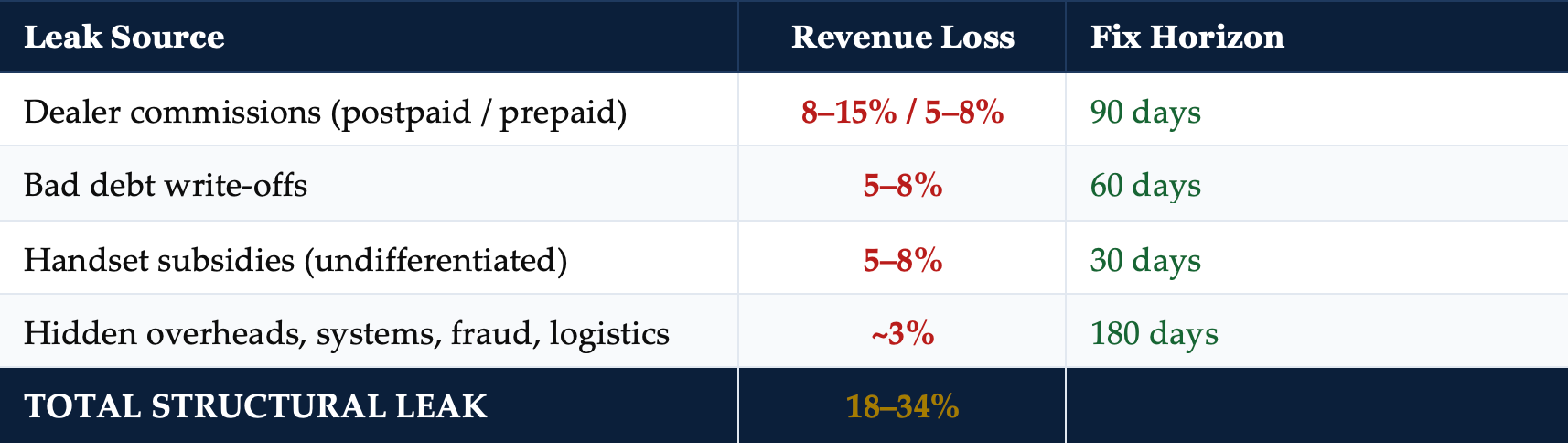
The 90-day fix (no transformation programme required): Commission holdback gated on 90-day active usage, channel paid on outcomes, not activations. Real-time activation intelligence: biometric KYC + credit scoring + dynamic subsidy eligibility in under 3 seconds. eSIM-first activation eliminates SIM logistics cost and creates the data foundation for everything downstream.
CTO gate: None of this works without a unified customer data layer. If your BSS cannot score credit risk at point of activation, your 90-day fix is a 9-month data readiness programme. Run that audit first.
Stop managing blended averages. A Tier P&L makes the cross-subsidy visible,and forces the decisions that fix it.
The airline analogy holds, with one qualification. Airlines don’t retain high-value customers through recognition alone; they retain them through economics. Points create switching costs. Status creates sunk-cost psychology. A ‘Titanium’ label without a loyalty currency and genuine switching friction is a marketing exercise, not a commercial strategy. Build the lock-in, not just the badge.
Each tier below must carry four attributes to be commercially real: (1) cost-to-serve, (2) CAC envelope, (3) service promise, (4) P&L target. If any tier lacks these, you are not running tier economics, you are running a segmentation model with better branding.
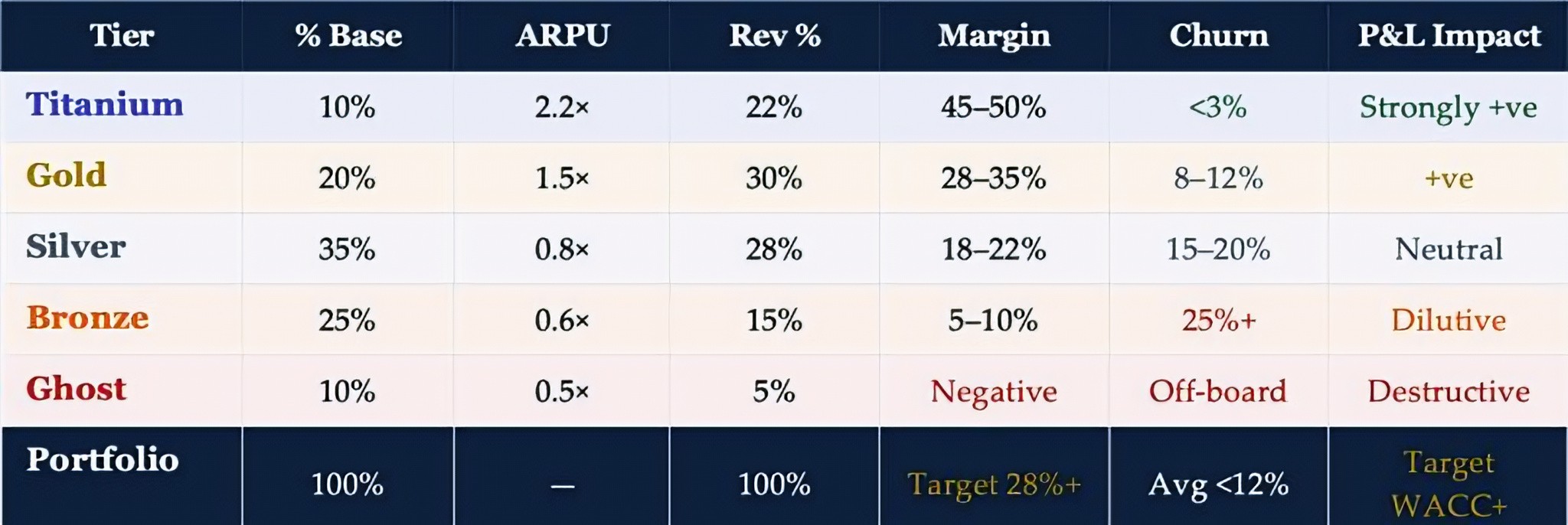
*Margins should be evaluated after allocating depreciation and amortization. Stopping at EBITDA can be misleading and may lead to incorrect conclusions, particularly for NVCs or Ghost segments.
On Ghost off-boarding: This is not a 90-day operational decision. In most SEA markets, Universal Service Obligations, prepaid deactivation regulations, and reputational risk constrain your options significantly. Before setting thresholds, engage legal, regulatory affairs, and government relations. The commercial logic is sound. The execution requires adult supervision.
Competitive response model: Before reducing Bronze investment, build switching friction for your top tiers. A competitor will absorb your off-boarded base. Some will reactivate. Sequence the defence before the offence.
Five structural moves that will define whether your operator leads the next decade or explains to investors why it didn’t.
If Huawei, Ericsson, Nokia, and Samsung are selling identical technology to every operator in your market simultaneously, why are you still owning and operating the infrastructure? Cloud computing answered this question for enterprise IT a decade ago. AWS, Azure, and Google Cloud proved that consumption-based infrastructure economics outperform owned-asset economics for most operators.
The proposal: issue a formal NaaS RFP to all four major vendors. Vendor-owned CAPEX. Guaranteed SLA with financial penalties. Revenue-share or per-bit pricing. Run the 10-year NPV against your current CAPEX plan. The CFO and CTO evaluate jointly. This single decision could redefine your balance sheet.
.jpg)
NaaS is most viable with >25% market share.
Real-Time Activation Intelligence, Close the 18% Leak Permanently
Pre-activation decision engine: credit risk score + 90-day churn probability + subsidy eligibility, in under 3 seconds. This is a financial controls system, not a CRM upgrade. Outcome-based channel platform releases commissions algorithmically at Day 90 , no gaming, no disputes, no bad debt surprises.
Loyalty Currency, Build Real Switching Costs
Points redeemable on device upgrades, roaming, streaming, and ecosystem partners,not bill discounts. Points-at-risk retention: show the customer what they forfeit before they churn. Documented to reduce voluntary churn 8–15% in FSP deployments. This is the missing ingredient in the airline analogy.
AI-Native Operations, Algorithm First, Human by Exception
Next-best-action at individual level,not segment offers. Predictive churn scoring weekly, automated intervention before the cancellation call. Autonomous service recovery: when a network event hits a postcode, Titanium customers receive proactive compensation before they complain. This is the most tangible CTO deliverable in the next 12 months.
Private 5G,The One Place Network Differentiation Still Exists
Enterprise and industrial customers (manufacturing, logistics, healthcare) buying private 5G, IoT management, and security from one provider have switching costs 3–4× higher than connectivity-only customers. This is the segment where ARPU economics are transformational,and where the CAPEX investment still earns a genuine return.
THE EXECUTION FRAMEWORK
A plan a CEO can mandate, a CFO can fund, and a CTO can build,with the pre-conditions stated honestly.
Pre-condition audit,run this before anything else: (1) Unified customer ID across prepaid, postpaid, broadband? (2) Cost-to-serve attributable at customer level, not product level? (3) BSS/OSS capable of real-time API access? (4) CEO-level cross-functional authority to override channel budgets? If any answer is no, your first 90 days are data readiness. Do not skip this step.
01. Build the Tier P&L,from real data
Tier every customer on ARPU, tenure, payment behaviour, multi-product, cost-to-serve, and churn risk. CFO owns the output. Data gaps become the CTO’s immediate mandate.
02. CTO Data Readiness Audit
Red/amber/green scorecard: customer ID completeness, cost-to-serve attribution, real-time API availability. This gates the entire programme.
03. Design Titanium, with switching costs, not just a badge
Bundle + loyalty currency + ecosystem partners. Pilot with top 1,000 customers. Measure Net Revenue Retention, not NPS.
04. Redesign channel incentives to outcome-based
50% commission on activation; 50% at Day 90 on usage and payment. The CEO holds the line on channel resistance. The CFO sees bad debt drop within 2 billing cycles.
05. Issue NaaS RFP to Huawei, Ericsson, Nokia, Samsung
Vendor-owned CAPEX, guaranteed SLA, revenue-share pricing. CFO + CTO evaluate NPV vs. current 10-year CAPEX plan. This is the highest-leverage balance sheet decision available to your board.
06. Launch loyalty currency + AI-native operations
Points economy live. Next-best-action replaces segment campaigns. Predictive churn intervention deployed. Autonomous service recovery for Titanium tier.
Three questions your board must answer before this leaves the room:
1. Which tier funds our ROIC,and which destroys it? (CFO deliverable: 60 days.)
2. What is the NPV of NaaS vs. our next 5-year CAPEX plan? (CFO + CTO joint brief: 90 days.)
3. Are we data-ready to run tier economics,or are we 12 months away? (CTO audit: 30 days.)
The operators who define the next decade will not own the most network.
They will serve the most profitable customers — on the best-available network, regardless of who owns it.

.svg)





.svg)
