.svg)

Blogs
A Tech Giant Goes Headless: Why Salesforce 360 is a Big Deal for Enterprise Software
June 30, 2026

.svg)
.svg)


Blogs

William Kiong Wai Lun


Last month, Salesforce co-founder Parker Harris asked a question no software founder is supposed to ask out loud: “Why should you ever log into Salesforce again?” At the TDX 2026 developer conference in April the CRM company turned that rhetorical jab into product direction and they announced Salesforce Headless 360 which officially makes its browser completely optional for users, exposing every capability the platform has built over 25 years as an API, an MCP tool, or a CLI command. The company that sold the screen for a quarter of a century just decided the screen was the wrong thing to sell.
Headless is not a new word (it dates to the 1990s with daemons and background servers). For a decade it has described software that splits the front end from the back end so developers can build their own interface on top of someone else’s platform, as in headless commerce or headless content management. Salesforce has borrowed the term and changed the way developers can build on top of its capabilities. Headless 360 exposes Data 360, Customer 360, and Agentforce as programmable endpoints, with more than 60 new MCP tools and 30 preconfigured coding skills that plug straight into coding agents like Claude Code, Cursor, and Codex. The difference that matters is the consumer on the other end. The old headless meant build your own screen for your use cases and to fix the occasional UI complaints. This version assumes no human screen at all, because the thing calling the API is an agent, and agents do not click.
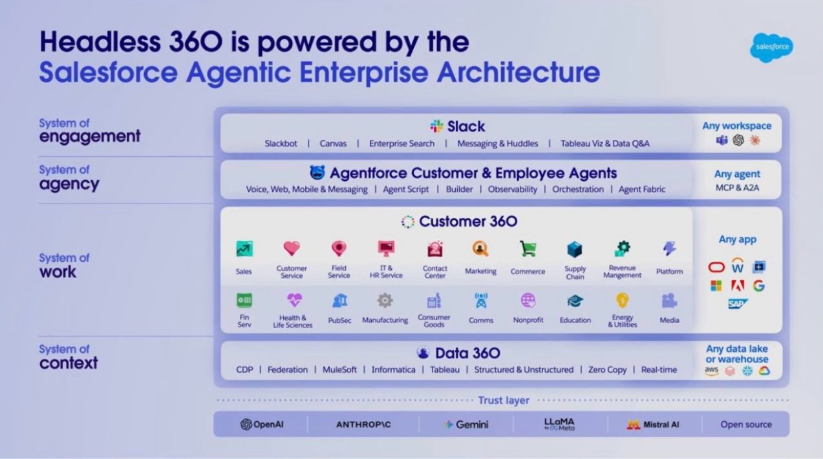
Salesforce describes the platform as four layers: a system of context (Data 360), a system of work (Customer 360), a system of agency (Agentforce), and a system of engagement (Slack). Headless 360 opens all four as programmable endpoints, but only one of them is genuinely new. As Salesforce MVP Gaurav Kheterpal noted after TDX, the architecture is mostly what it always was; the major change took place in the agency layer, where any agent speaking MCP or A2A can now slot in and form connections. The rest was already built, which is the whole of Salesforce’s argument: yes, the surface has changed, the core platform did not.
The move only makes sense because of the fear that is growing around prominence of AI-generated software or the “SaaSpocalypse”. Enterprise software (e.g., Oracle, Salesforce, Adobe, Datadog among others) spent late 2025 in a sell-off, with the iShares Expanded Tech-Software ETF down roughly 28% from its September peak, on a single worry: that AI agents would make traditional SaaS obsolete. If an agent can reason, plan, and act, who needs a CRM with a graphical interface that was initially designed for humans? Salesforce’s answer is to agree, then made the pivot. The bet is that its moat was never the interface. It was 25 years of accumulated data, workflows, business logic, and a trust CRUD layer that no coding agent can generate from a blank prompt. A coding agent wired to a raw database, as Salesforce frames it, has no way of knowing that a customer has an open escalation, a renewal due in 30 days, and a relationship owner who knows their CFO personally; that context took years to build, and it lives in Salesforce.
This is not a hedge against a hypothetical phenomenon. The company’s Agentforce business is already pulling $540 million in annual recurring revenue across 18,500 customers, and the deployments are named and in production. PenFed Credit Union now runs 76 agents across operations, mortgages, IT, and HR, with the contact-centre rollout alone projected to save $1.6 million a year, its CEO told a recent Salesforce earnings call. Analysts read the launch as a major platform model shift from system of record to system of execution that is forcing a rethink of its TAM. Dion Hinchcliffe of The Futurum Group put it plainly: Salesforce knows the centre of gravity is moving toward coding agents and external runtimes, so it is trying to stay as the system underneath. The judo is elegant. Every coding agent that threatened to replace Salesforce now has a reason to build on it instead.
Salesforce is not alone. SAP is rebuilding around an Autonomous Enterprise whose Joule Work layer replaces screen-by-screen navigation with an AI conversation. At Adobe’s summit, Nvidia’s Jensen Huang told the room that the front end of every SaaS platform is now agentic. The wager underneath all of them is built on the same premise, which is AI will commoditise the interface but not the business logic beneath it. For CTOs and CPOs, that quietly rewrites how they evaluate software purchases. You are no longer paying for screens and seats. You are paying for the context, workflows, and governance an agent inherits the moment it decides to act, which is exactly where the value is.
There is, however, a catch Salesforce is not saying loudly. Headless 360 is built for the developers who live in MCP tools and have rarely opened the Setup menu, while the ecosystem of admins and low-code builders who grew the ecosystem slowly watched their beloved tool evolve into a different animal. The commercial questions are open too. Headless 360’s launch said nothing about pricing, licensing, or the SLAs for MCP tool calls that real-time agents depend on. That omission matters as Salesforce has already churned through three pricing models for agents in two years, from $2 per conversation to consumption-based Flex Credits to a per-user “digital labour” license, simply because nobody has settled what a unit of agentic work is worth. Across B2B software, seat-based pricing as the primary model slipped from 21% to 15% of companies in a single year. Going headless removes clicks, but it adds governance and skills debt, and it unsettles the one thing buyers thought they understood: what the seat is for.
The head is not disappearing. It is multiplying, rendering the same workflow into Slack, Teams, WhatsApp, and ChatGPT from a single definition. That is the uncomfortable part for every vendor watching Salesforce: when the interface becomes optional, the product is whatever survives without it. Salesforce is betting that what survives is everything it spent 25 years accumulating beneath the screen. The question its rivals and its customers now have to answer is the one Parker Harris asked first. If you never log in again, what exactly are you paying for?

.svg)



.jpg)


.svg)
