The Most Underrated Lever in Business Is Right Under Your Nose
Why the C-Suite obsesses over costs and ignores the one decision that moves the needle most.
CFOs spend months crafting a Financial Limits of Authority framework. The VP needs sign-off for a $100,000 purchase jointly with the CFO. Yet that same VP can make a pricing call that swings the company by millions. No committee. No board note. No policy. We have built elaborate governance around every dollar that flows out, and almost none around the price at which revenue flows in.
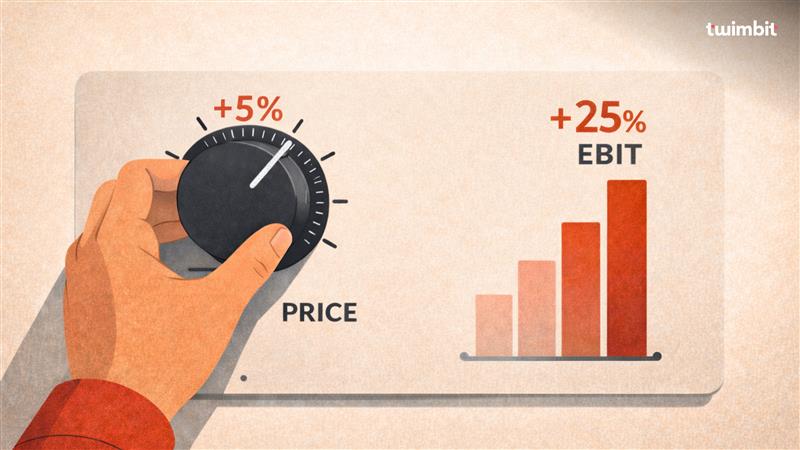
“A 5% increase in price drives a 25% increase in EBIT at 20% margins. No cost programme delivers that leverage, that fast.”
1. The Invisible Governance Gap
Your controls are built backwards
Boards scrutinise every line of cost. But ask: “What is your pricing policy?” and the room goes quiet. A 100,000 purchase needs three signatures; a pricing decision reshaping hundreds of millions in revenue is made informally, reactively, with no framework. Pricing deserves a seat at the governance table alongside capital allocation.
When a competitor drops price, most companies follow within days, no analysis, no modelling, no board visibility. Is that strategy? Or panic dressed as competitive response? Matching a competitor’s discount is the most expensive decision a business makes and the least examined.
2. Pricing Is Not a Number. It Is a Statement of Identity.
The most innovative organisations have turned pricing into a competitive weapon, architectured models that change behaviour, expand revenue pools, and redefine what a business sells.
Rolls-Royce -Power by the Hour
“We don’t sell engines. We sell thrust.” Charges airlines per flying hour instead of a $25M engine sale, aligning incentives perfectly: keep the engine running. Capital sale becomes recurring revenue and long-term partnership.
BMW & Apple -The Price Floor as Brand Armour
“Discount the price and you discount the dream.” For premium brands, a lower price signals something has gone wrong. Apple and BMW have held this line for decades. Volume is not always victory; brand elasticity matters as much as price elasticity.
Airlines -Dynamic Yield Management
“An empty seat at departure is revenue that died.” Real-time pricing matched to willingness-to-pay across millions of micro-decisions. The load factor is the scorecard, perishable inventory demands intelligent pricing systems.
AirAsia -Radical Transparency Pricing
“Cheap and proud of it - but on our terms.” Built an entire experience around low prices: bare-bones, efficient, honest. It works only because the pricing was deliberate, not reactive. Know your lane and own it completely.
AWS -Consumption Pricing
“Pay for what you use. Scale as you grow.” Granular per-millisecond pricing removed the biggest barrier to adoption: upfront commitment. Customers scale spend as they scale business, the price architecture built the moat.
Michelin -Pay Per Kilometre
“We charge for distance, not rubber.” Truck fleets pay per kilometre covered instead of buying tyres outright. Fleets convert capex to opex; Michelin earns more over the vehicle’s life. Power by the Hour, applied to the road.
Spotify -Freemium Architecture
“Let them in free. Let the experience sell the upgrade.” Ad-supported free builds habit; the friction converts users to $11.99/month Premium. The free tier is not charity, it is the most efficient sales funnel ever built.
Real Estate -Floor-by-Floor Differentiation
“The 22nd-floor corner view is worth more. Are you charging for it?” Floor-rise and view premiums, standard in Singapore and Dubai, can add 8–15% to total project realisation without a single brick more. Pricing per sq ft should never be flat.
John Deere -Hardware as Trojan Horse
“The tractor was the beginning. The data is the business.” Sells equipment, then charges subscription for precision agriculture software. Three seasons of yield data creates switching costs no competitor can overcome. Modest subscription price; absolute lock-in.
3. Pricing as a ROIC Driver
Most ROIC improvement targets the denominator, sweating assets, cutting costs. Far fewer attack the numerator. A 3% pricing improvement on a $500M revenue business is $15M flowing almost entirely to the bottom line, no new headcount, no capex. At 20% EBIT margins, that moves EBIT from $100M to $115M. A 15% jump. From pricing discipline alone. When did your board last model that?
4. Bundling Is the Strategy; Discounting is not
Control what goes together and you control what the customer pays
Done well, bundling raises average transaction value, reduces per-item price scrutiny, and obscures competitor comparison. The bundle reframes three purchase decisions into one — more profitable than the sum of its parts while the customer still feels they got a deal.
McDonald’s & KFC — Engineering the Transaction
“They’re not selling you a burger. They’re engineering a margin.” Fries and beverages carry 70–80% margins — far above the burger. The Meal anchors customers on one price while maximising high-margin attachment. Every upgrade prompt is a rehearsed upsell. Counter staff are pricing strategists in uniform.
Microsoft 365 — The Bundle That Locked Out Rivals
“Why buy best-of-breed when the bundle beats the alternatives?” Word, Excel, Teams, OneDrive, Copilot AI — one subscription. No single-product rival can match the gravity. Revenue per user grows every time a new tool is folded in, with no new sales cycle needed.
Telcos — Triple Play Bundles
The more services bundled, the harder it is to leave.” Triple play (internet, TV, phone) is less about discount, more about churn reduction. Three services, one bill, one contract — customers almost never leave. Moving 15% of a 20M-sub base to dual-service at $10 premium = $36M ARR at zero acquisition cost.
5. Questions Every Board Should Be Asking
If your board isn’t asking these, nobody is
Do we have a written pricing policy and does the board see it?
What is our price elasticity by segment, and when did we last formally test it?
Are pricing decisions made proactively or are we reacting to competitors?
When a competitor cuts price, what is our framework? Who decides? In how many hours?
Are we capturing differentiated value across segments, geographies, and channels?
Is discounting authority governed commensurate with the revenue at stake?
Have we modelled the ROIC impact of a 3% pricing improvement?
Do we have a Chief Pricing Officer or is pricing an orphan that belongs to no one?
“Cost management is fighting yesterday’s battle. Pricing strategy is winning tomorrow’s.”
The CFO who builds pricing governance, the CEO who asks hard pricing questions in the boardroom, and the leadership team that treats price as a strategic asset, not an afterthought, will unlock a lever most competitors have left untouched. The money is already there. Stop leaving it on the table.
.svg)


.svg)
.svg)











.svg)

.svg)
