.svg)

Blogs
Telcos start feeling the heat amid disruptions and investment cycle.
May 29, 2026

.svg)
.svg)


Blogs

Sanskar Rathee


Singtel’s H2 FY2026 results triggered a sharp market reaction, but the outcome was not entirely surprising. While the headline numbers showed resilience, the underlying trends highlighted a company still facing pressure in its core telecom operations while entering another heavy investment cycle.
The Group reported a 2.7% YoY increase in operating revenue during H2 FY2026, supported mainly by NCS, Digital InfraCo and Optus. However, investors focused less on the reported growth and more on the outlook management provided for the coming year.
Singtel Singapore continues to face structural challenges in a mature and highly competitive market. Revenue from the Singapore business declined 5.2% YoY during the period. Mobile service revenue fell 9.2%, driven by lower pricing, weaker roaming revenues and growing competition from travel eSIM providers.
The weakness extended to Data and internet as revenues declined because of pressure on legacy leased circuits and lower home broadband equipment sales, while ICT revenue fell due to softer demand and lower data centre revenue after the customer migration to Nxera.
These results reinforce a broader issue facing developed market telecom operators. Traditional connectivity businesses are becoming increasingly difficult to grow in saturated markets where pricing power remains weak and competition continues to intensify.
Optus tells a more complicated story. Operationally, the Australian business showed signs of improvement. Revenue increased 2.4% YoY, supported by mobile growth and higher network sharing revenue. Mobile service revenue rose 3.3% due to postpaid price hikes and prepaid subscriber growth.
However, the business is still recovering from the fallout linked to the emergency call outage last year. Singtel continued to incur regulatory and remediation-related costs while investing heavily to improve network resilience and operational standards.
The planned minority stake sale in Optus further highlights the strategic uncertainty surrounding the business. While Singtel is positioning the move as a way to unlock value and bring in a strategic partner, investors may see it as an attempt to reduce exposure to a market that continues to face operational and regulatory pressure.
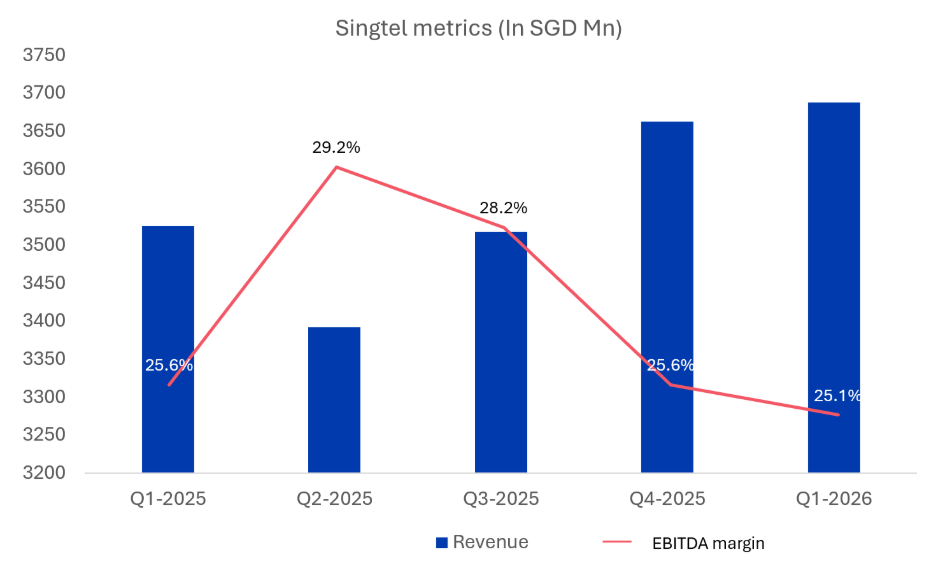
The biggest reason behind the share price decline was management’s guidance for FY2027.
Singtel warned that EBIT growth is expected to remain between low and mid single digits due to macroeconomic uncertainty and geopolitical risks. The Group highlighted concerns around inflation, softer consumer spending, currency volatility and slower economic growth across many of its key markets.
This cautious outlook overshadowed the otherwise stable operational performance. Investors are increasingly evaluating telecom operators based on future growth visibility rather than current earnings stability, and Singtel’s guidance suggested limited near-term acceleration.
The company is also preparing for another major investment phase. Total capital expenditure for FY2027 is projected to reach around S$3 billion, with an additional S$1.2 billion expected to be invested in AI infrastructure, GPU-as-a-Service facilities and data centres.
While these investments could strengthen Singtel’s long-term positioning, they also raise concerns around capital intensity and future returns.
NCS and Digital InfraCo continue to offer Singtel its strongest growth engines, driven by enterprise demand, AI services and Nxera’s expanding data centre footprint. Through Nxera and RE:AI, Singtel is increasingly positioning itself beyond traditional telecom operations.
The transition accelerated further with the STT GDC acquisition, which strengthened Singtel’s exposure to hyperscaler demand, GPU infrastructure and regional AI data centre growth. As a result, the market is gradually valuing Singtel more as an AI and digital infrastructure player rather than a conventional telecom operator.
However, that transition also comes with a heavy investment cycle. Singtel expects around S$3 billion in FY2027 capex, including significant investments into AI infrastructure and data centres. While this could strengthen the Group’s long-term positioning, investors remain cautious about whether returns can materialise quickly enough to justify the scale of investment.

.svg)






.svg)
