.svg)

Blogs
Should You Still Invest in SAP, Oracle, or Microsoft ERP?
A practitioner's answer to the question every ERP client is asking in 2026
A practitioner's answer to the question every ERP client is asking in 2026
April 6, 2026

.svg)
.svg)


Blogs
A practitioner's answer to the question every ERP client is asking in 2026

Chari TVT


Every ERP engagement I am currently advising has the same conversation in the room: the CFO has read that Satya Nadella declared SaaS dead. The CTO has seen Klarna ditch Salesforce and Workday. The Board has noticed that SAP has lost a third of its market value from peak. And someone always asks: are we about to spend $50 million on yesterday's infrastructure?
The honest answer is: it depends entirely on which part of the ERP stack you are buying. The disruption is real. It is also wildly uneven. Here is what I tell my clients.
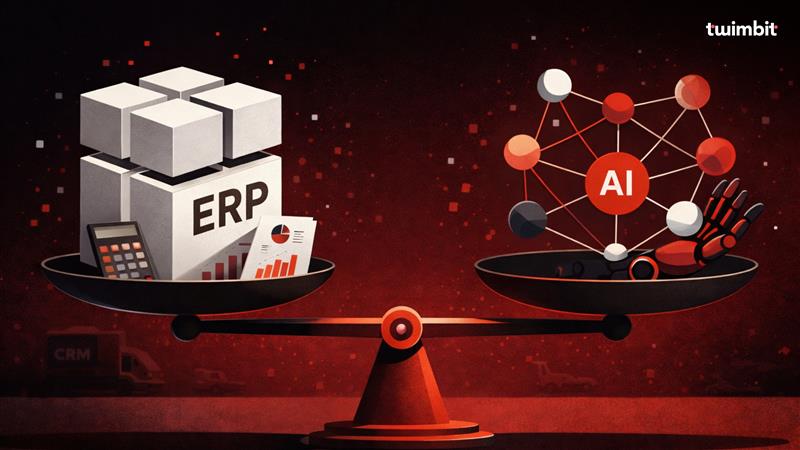
The question is not whether to invest in ERP. It is where in the ERP stack the AI threat actually lands, and where it does not.
Two things happened in early 2026 that are genuinely significant, not just market noise.
First, Anthropic launched Claude Cowork and OpenAI launched Frontier, both explicitly positioned as AI orchestration layers that sit above CRM, ERP, and HCM systems, routing autonomous agents across them. The system of record does not disappear; the user interface and the workflow layer above it get rebuilt. This is the 'system of context' argument made real.
Second, Zoho launched full ERP in India at roughly three dollars per user per month, against SAP's hundred-plus dollars. The US launch is later this year. Margin compression on per-seat licensing is coming regardless of what AI does to workflows.
What has not changed: decades of regulatory logic, statutory compliance across 100-plus jurisdictions, audit frameworks, and process memory embedded in enterprise ERP systems. Workday's CEO put it plainly: these systems 'must process transactions with absolute accuracy, enforce complex security models, and comply with statutory and regulatory requirements all over the world.' No AI startup is going to replicate that in 24 months.
The single most useful frame for an ERP investment decision right now is not vendor versus vendor. It is module versus module. AI disruption risk is sharply differentiated by what the software actually does.

Klarna became a headline for replacing Salesforce and Workday with AI. Three things got lost in the retelling.
Replacing SAP lock-in with OpenAI lock-in is not risk elimination. It is risk substitution, and with an immature vendor at that.
Invest now in Finance, Supply Chain, Procurement, and Core Logistics. The AI risk here is augmentation, not replacement. These modules will get smarter. SAP Joule, Oracle AI agents, Microsoft Copilot in D365 and others are all moving in this direction, but the transactional backbone is not going away. The cost of waiting is real: every year on a legacy system is a year of compounding technical debt, regulatory lag, and competitive disadvantage in planning capability.
Negotiate harder than ever. The market shift is genuine leverage. SAP, Oracle, and Microsoft know Zoho is coming. They know AI orchestration platforms are a threat to their user-layer revenues. Use this in contract negotiation. Lock in pricing and implementation terms now, before the next round of vendor AI hype inflates consulting costs.
Hold or restructure CRM and standalone point solutions. If you are considering a net-new Salesforce implementation for a client not already on the platform, make the case for a 12-month reassessment window. Agentforce changes the value proposition, and the AI orchestration alternatives are moving fast.
Always demand AI-readiness as a non-negotiable criterion. Any ERP platform selected in 2026 must have a credible, deployed AI agent strategy, not a roadmap, a product. SAP Joule, Oracle AI Agents, and Microsoft Copilot in D365 all qualify. A platform without a deployed AI layer in 2026 is already behind.
The operational risk argument
For any client tempted by the narrative of moving to an AI-native platform, the operational risk case must be stated clearly: ERP migration failure rates are below 30 percent on time and on budget under ideal conditions. AI-native platforms add regulatory ambiguity, immature enterprise support structures, and the risk of trading one form of lock-in for another.
The enterprises moving aggressively to AI-native alternatives share a profile: fintech, digital-native, with high internal engineering capability and minimal regulatory complexity. That is not the profile of most of my clients, and probably not yours.
The SaaS apocalypse narrative is part signal, part panic. The signal: AI is restructuring the value layer above systems of record, and per-seat licensing economics are under pressure. The panic: core ERP (finance, supply chain, logistics, procurement) is being conflated with the CRM and point solutions that are genuinely at risk.
For clients sitting on ERP migration decisions in 2026: the answer is not to wait for the dust to settle. The dust will not settle. Invest in the right modules, with the right vendors, at better commercial terms than were available two years ago, and build AI readiness into the selection criteria from day one.
The window for doing this thoughtfully, rather than reactively, is open. It will not stay open indefinitely.

.svg)






.svg)
