.svg)

Blogs
Patient Care in the Age of Agentic AI
February 3, 2026

.svg)
.svg)



Blogs
.jpeg)
Harshit Gulati


A patient only cares whether the AI delivers care that works: whether the fever drops, whether the right specialist is looped in before things escalate, whether treatment starts in minutes, not after a queue.
That’s why some of the most important AI progress in healthcare is no longer happening in a chat window. It’s happening inside closed loops, systems that sense, decide, and act in the real world.
From a CX lens, Agentic AI is rewriting patient experience around three outcomes:
When AI can run these loops reliably, patient experience stops being a front-end problem and becomes an operating model advantage.
Most healthcare AI today still behaves like an assistant: it summarises notes, drafts documentation, or suggests next-best actions. Useful—but still dependent on humans to execute and own outcomes.
Agentic AI is a different leap. It doesn’t just respond—it orchestrates. It uses tools, triggers workflows, and executes tasks under defined constraints. The interface is no longer a chat. The interface is a loop: sense → decide → act → escalate.
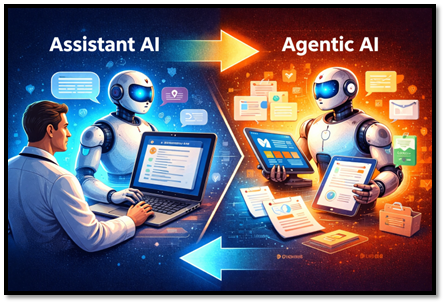
You can see this shift even in clinical development operations, where companies are using AI to automate trial management and regulatory documentation. What’s emerging next is agentic AI, systems that can run multi-step work with minimal human intervention—and could lift clinical development productivity by ~35% to 45% over the next five years.
This matters because the next phase isn’t about better answers. It’s about better outcomes.
1) The clinic that looks like a photo booth
Imagine walking into a booth that feels closer to a mall kiosk than a clinic. You describe symptoms, capture basic vitals, receive guidance for routine conditions, and (where appropriate) get medicine on the spot. If the case looks serious, the system packages your information and routes you to a clinician or a hospital.
China has been piloting and scaling versions of this model for years. Ping An Good Doctor's "One-minute Clinic" concept, for example, combined an AI intake and symptom flow with a connected doctor for oversight, plus a smart medicine cabinet stocked with common drugs.
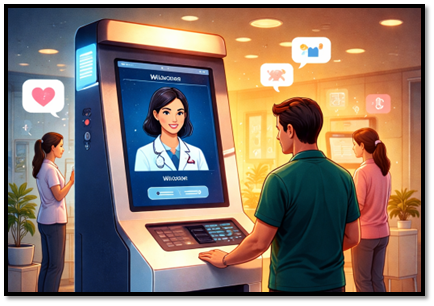
The takeaway is not that kiosks replace doctors. It is that they redesign the front door of healthcare into a self-serve operating loop for routine needs, while keeping escalation paths clear for complex cases.
From a patient experience lens, kiosks primarily improve time-to-first-action and first-contact resolution for routine needs, removing the most common friction: waiting just to be told what happens next.
CX takeaway: Kiosks turn “access” into a predictable self-serve loop—cutting time-to-first-action
2) The invisible waiting room: prior authorisation
A lot of patient frustration happens before care even starts, when treatment is delayed by insurer approvals. In the American Medical Association’s 2024 survey, more than 9 in 10 physicians said prior authorization delays access to necessary care.

A concrete example of agentic AI here is Cohere Health’s AI-powered Ambient Prior Authorization initiative, integrated with Microsoft’s Dragon Copilot. The idea: during the visit, ambient capture can trigger AI agents to pull the right documentation and submit a care request in real time, reducing back-and-forth and speeding access to care.
CX impact: faster time-to-care, fewer “we need more info” loops, clearer status/escalation.
3) Post-discharge continuity: Agentic AI that checks on patients after they leave
The patient journey doesn’t end at discharge, yet that’s where confusion spikes: medication steps, symptoms, and “should I worry?” questions.
A real initiative is Universal Health Services (UHS) + Hippocratic AI, where GenAI agents make post-discharge check-in calls to review instructions, probe for new/worsening symptoms, and answer routine questions, then escalate to a human nurse/clinician when needed.
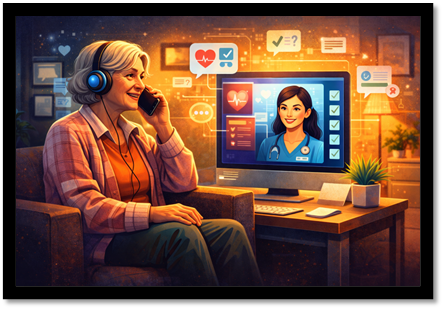
What makes this agentic (not just conversational) is the closed-loop execution: platforms like Hippocratic AI also describe capabilities to schedule outreach at scale and generate a structured post-call summary with suggested action items for clinician review—turning a call into an operational handoff, not just a chat.
CX impact: fewer drop-offs, earlier issue detection, higher confidence during recovery.
These are not disconnected stories. They are the same pattern applied to different “break points” in patient care, where experience is won or lost:
In all three, the interface is not the chatbot. The interface is the care loop—sense → decide → act → escalate, measured by time-to-care, continuity, and safety under pressure.
The real question is not whether AI will be used in hospitals. It is which parts of care you are ready to turn into safe, auditable closed-loop systems - and which parts must remain deeply human.

.svg)






.svg)
