.svg)

Blogs
Our Ability to Visualize Far Exceeds Our Ability to Execute
March 11, 2026

.svg)
.svg)


Blogs

Manoj Menon


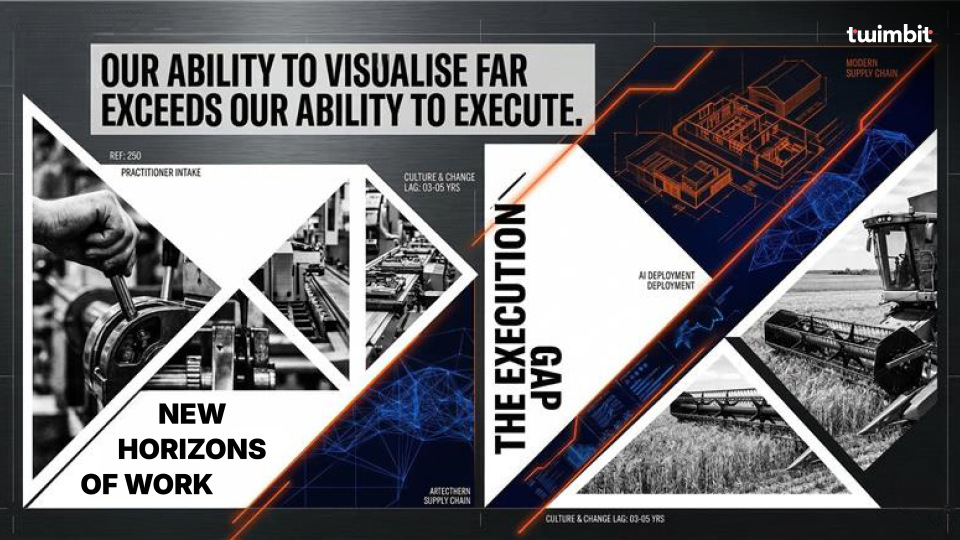
The recent Citrini 2028 forecast report painted an audacious view of a frictionless, AI-driven world. It is a compelling vision of what is possible, yet as I reflect on the past year, a more grounded and perhaps more inspiring reality has emerged. Our ability to visualize far exceeds our ability to execute. This is the central tension of our era. While we can imagine a world transformed by intelligence, the actual work of integration requires a level of persistence and organizational change that is often overlooked in near-term forecasts.
Over the last twelve months, I have had the privilege of speaking with more than 250 practitioners. These are the individuals responsible for turning a high-level vision into a functional reality within their organizations. Their daily experience reveals that while the raw power of AI is undeniable, the path to true implementation is not a simple sprint. It is a marathon of cultural and systemic change. These practitioners are the ones navigating the daily challenges of deploying technology into legacy environments, reminding us that innovation only matters when it is successfully adopted.
We must remember that while software can be updated in seconds, the physical industries that form the backbone of our society operate on entirely different timelines. In Agriculture, you cannot simply prompt a change in soil health or accelerate a biological growth cycle. Execution here requires respecting the laws of physics and the delicate balance of local ecosystems. Similarly, in Manufacturing, debugging a physical assembly line or integrating autonomous systems into a factory floor is a high-stakes endeavor. It is not just about the digital brain; it is about the physical body, the sensors, the supply chains, and the people who must learn to trust a new co-pilot.
Perhaps nowhere is this "last mile" more critical than in Healthcare. While we can visualize AI-driven diagnostics and personalized medicine, the reality involves complex regulatory environments, clinical trials, and, most importantly, the sacred trust between a patient and a provider. We are shifting our focus from merely extending lifespan to expanding the quality of our health span, but this requires a fundamental shift in how organizations behave. This integration will take time because it requires us to solve for human empathy and patient outcomes alongside technical accuracy.
A second and equally vital hurdle to rapid execution is the foundational requirement of trust. We cannot have a broad-based AI transition without robust cybersecurity guardrails. Security should never be viewed as a feature we add at the end of a project; it must be the essential design-win at the very beginning. Developing these safeguards to ensure that data remains private and systems remain resilient is a prerequisite for the velocity we all desire. Furthermore, the rise of sovereignty as a new dimension means that every nation and corporation will need to build its own intelligence stack that reflects its unique values and legal frameworks.
There is a common anxiety that as AI advances, the work for humans will eventually disappear. My conversations with those on the front lines suggest the exact opposite. Every time we cross a new milestone, we do not find a finish line. Instead, we find a new horizon of problems that are finally within our reach to solve. Whether it is finding new ways to create an abundance of nutritious food or more sophisticated ways to defend our digital perimeters, we are finding that as the cost of routine tasks drops, it creates the cognitive space for us to address the most pressing challenges of our time.
The execution gap is not a failure of technology. It is a call to action for human leadership. The winners of 2028 will not be those with the most visionary slides, but those with the cultural endurance to manage the messy middle of implementation. Our goal is not to build technology that replaces human agency, but to build a scaffolding for human potential. We have a tremendous amount of work ahead of us. Let us focus our energy on the execution.

.svg)






.svg)
