.svg)

Blogs
Omotenashi
What Japan's Service Culture Can Teach Every CX Team
What Japan's Service Culture Can Teach Every CX Team
April 17, 2026

.svg)
.svg)


Blogs
What Japan's Service Culture Can Teach Every CX Team
.jpg)
Mahek Rawat



You arrive at a Tokyo ryokan after a long journey. Before you say a word, a staff member greets you by name, hands you a warm towel, and leads you to a room where your preferred tea is already steeping. The window faces the garden you mentioned once, months ago in a reservation note.
Nothing was requested. Everything was done.
That is Omotenashi. Not a policy. Not a playbook. A belief system that says the person in front of you deserves your complete attention, your best effort, and your genuine care, every single time.
Japanese companies have been proving what that looks like in practice for decades. Here is what CX professionals can learn from them.
The word comes from omote (surface, what is shown) and nashi (without). Together: service with nothing held back: no performance, no hidden agenda, no expectation of return. Its roots lie in the Japanese tea ceremony, where every gesture was calibrated entirely around the guest. The host's role was to disappear so the guest could feel completely at ease.
In a CX context, Omotenashi has four defining qualities:

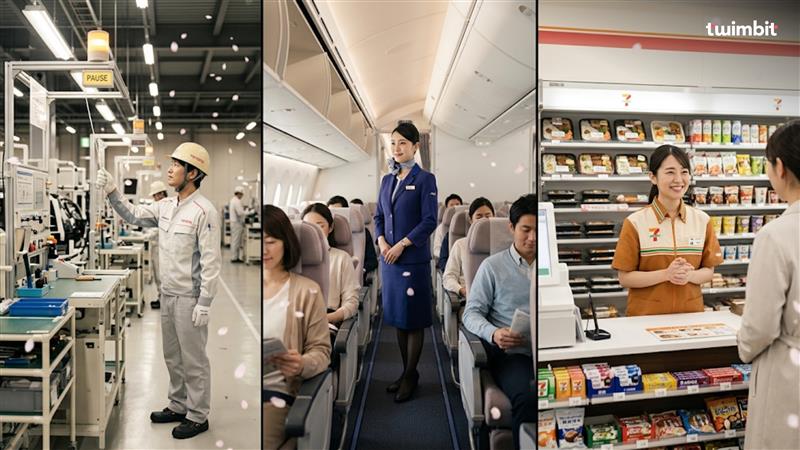
These are not aspirational examples. They are operating standards, sustained across thousands of employees, every day


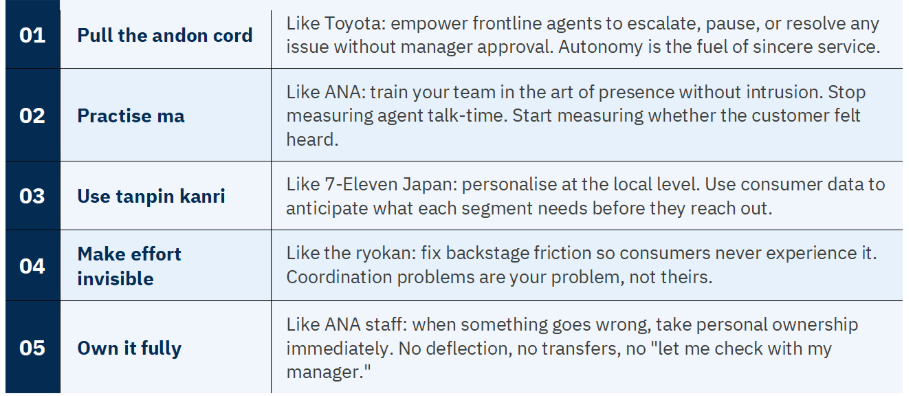
Omotenashi is not a training module you can roll out in a quarter. It is a culture, one that lives in the values of every person in the organisation, from the CEO to the most junior frontline agent. Most Western CX operations are built around a different set of values: efficiency, throughput, cost-per-contact.
"The gap between Omotenashi and most CX operations is not a gap in technology. It is a gap in belief."
That said, AI can help close the distance if used with intent. Predictive models can surface the consumer need before it becomes a complaint (anticipation). Automation can absorb repetitive queries so human agents focus on the interactions that require genuine empathy (invisible effort). The risk is AI that replaces sincerity rather than enabling it. Used the Toyota way, AI is the andon cord, it surfaces problems early so humans can fix them with care.
Back to the ryokan.
The guest did not fill out a preference survey. They mentioned a garden once, in a note, months ago. And someone remembered. That is the difference between a service operation and an Omotenashi culture, not the technology, not the process, but the depth of attention brought to every single interaction.
Toyota, ANA, and Seven-Eleven Japan are not outliers. They are proof that this standard is achievable at scale across factories, aircraft, and 22 million daily transactions. The question for your CX team is not whether Omotenashi is relevant. It is: what would your version of the ryokan moment look like?
"Omotenashi does not give you a script. It gives you a standard. And once you have felt what that standard looks like, you cannot unsee it."

.svg)






.svg)
