.svg)

Blogs
Navigating the SaaS‑pocalypse: Why the Software Boom Is Hitting Its Breaking Point
Not Dead. Not Immortal. Just Forced to Grow Up.
Not Dead. Not Immortal. Just Forced to Grow Up.
March 17, 2026

.svg)
.svg)


Blogs
Not Dead. Not Immortal. Just Forced to Grow Up.

Chari TVT


"SaaS is dead." , Satya Nadella, CEO Microsoft, December 2024 The most consequential sentence in enterprise tech. But is it? Read on.
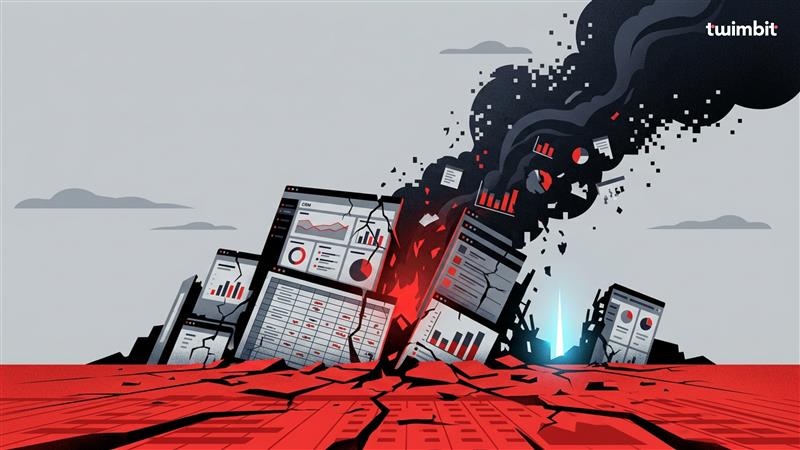
When the chief executive of the world's most valuable software company declares a business model dead , one that his own company helped build,the market doesn't debate. It sells. And sell it did. Between mid-2025 and March 2026, approximately $2 trillion in market capitalisation evaporated from enterprise software. The iShares Software ETF (IGV) fell ~30% from its September 2025 peak. In a single trading session in February 2026, Anthropic’s launch of Claude Cowork erased $285 billion in software market cap, catalysing concerns that were already building across the sector. The SaaSpocalypse had a name. And a body count.

Yet Gartner projects global software spending will hit $1.4 trillion in 2026, up 14.7%. SaaS revenue is forecast to grow from $318B to $576B by 2029. The market is not dying. It is being violently repriced. Those are two very different things.
The death certificate was for an architecture, not an industry.
Nadella's argument was not commercial, it was architectural. Traditional SaaS applications, he argued, are fundamentally CRUD databases (Create, Read, Update, Delete) wrapped in business logic. They were designed for humans to navigate software. In the age of AI agents, that design pattern is becoming obsolete.
"Business applications are CRUD databases with business logic. All that logic is moving to AI agents that work across multiple repositories simultaneously.", Satya Nadella
His vision: instead of a sales manager logging into Salesforce, navigating dashboards, and manually updating records, an AI agent receives a single instruction: "Close last week's pipeline and prep the board forecast." It acts. Across CRM, ERP, finance. No interface. No seat licence. Just outcome. IDC called this "AI as the new interface layer." It predicted that by 2028, pure per-seat pricing will be largely obsolete, with 70% of vendors forced to reprice around consumption or outcomes.
This is the distinction that separates the threatened from the durable.
A System of Record (SoR) is the authoritative data source for a business domain. Salesforce owns customer relationships. SAP owns financial transactions and supply chains. Workday owns HR and payroll. These are not applications, they are the bedrock of enterprise data truth.
A System of Context (SoC) is the intelligence layer that wraps data in meaning and orchestrates workflows. Historically, this lived inside SaaS applications, in dashboards, rules engines, and user interfaces. Today, AI agents are absorbing this layer. They read from any SoR, reason across all of them, and deliver outcomes, without requiring users to touch the application at all.
The AI disruption thesis in one sentence: if AI agents become the System of Context, what competitive advantage remains for the SaaS layer that currently provides it?
This is the argument made by a wave of AI-native startups. And Klarna tested it. In 2024–25, CEO Sebastian Siemiatkowski announced the elimination of 1,200 SaaS tools, including Salesforce and Workday, replacing them with internally built AI. The company reported an AI customer service system that replaced 700 agents and generated $40M in annual savings. Revenue per employee leapt from $400K to $700K.
Then came the correction. By early 2025, Siemiatkowski publicly acknowledged the approach had gone too far. Quality had suffered. Rehiring began. Klarna is now the most quoted cautionary tale in enterprise AI, because it proved both sides of the argument simultaneously. AI can do more than most enterprises admit. But it cannot yet do everything that a decade of enterprise deployment has quietly encoded into a company's operational DNA.
Years of enterprise data aren't a legacy burden. They're the moat.
The CEOs of the world's largest SaaS companies have responded with a consistent thesis: the institutional trust, regulatory complexity, and cross-customer intelligence embedded in enterprise-grade deployments are not easily replicated by an AI system that learned from the internet, not from 30 years of Fortune 500 deployments.
Marc Benioff (Salesforce): "This wasn't our first SaaSpocalypse." Salesforce's real-time platform now manages 50 trillion customer records. No AI startup can replicate that proprietary data asset in a sprint cycle. Agentforce, Salesforce's AI agent platform, crossed $500M ARR with 330% growth. Benioff's reframe: Salesforce is no longer a SaaS vendor. It is an AI operating system for customer relationships.
Aneel Bhusri (Workday): His sharpest line: "The three AI companies investors think will replace Workday, Anthropic, Google, OpenAI, are all Workday customers." The regulatory depth, compliance logic, and institutional memory in Workday's HR deployments cannot be reverse-engineered by a general-purpose language model, however capable.
Bill McDermott (ServiceNow): "AI is devouring features-and-functions companies. ServiceNow is the semantic layer that makes AI ubiquitous in the enterprise." McDermott's reframe is the most aggressive: ServiceNow is not threatened by AI integration, it is the infrastructure through which AI integration happens.
SAP: A company that builds its own AI-powered ERP on top of its own data will have a pond. SAP, having learned from thousands of enterprise installations simultaneously, has an ocean. That cross-customer intelligence compound is the asset that no single-company AI deployment can match.
Shipping a v1 AI prototype that replicates a CRM workflow is roughly 2% of the work. The remaining 98%, compliance, security, audit trails, global integration, and the institutional knowledge of 10,000 deployments, is where incumbents are untouchable.
Jensen Huang (Nvidia) dismissed the SaaSpocalypse as "illogical." Scott Galloway (NYU Stern) was blunter: "I'm buying SaaS stocks. It is farcical to think companies will cancel Salesforce to write ChatGPT prompts." James St. Aubin of Ocean Park Asset Management: "Proprietary data is the deepest moat by far."
The market is repricing a disruption. Not writing an obituary.
Three structural pressures are genuine and will not abate:
① The Seat-Based Model Is Structurally Broken. When one AI agent handles the workload of five CRM operators, the per-seat revenue model compresses from both sides. Atlassian's Q3 2025 earnings showed enterprise seat counts declining for the first time in company history. IDC calls this inflection point irreversible. The companies that reprice around consumption, outcomes, or organisational capability will survive. Those married to headcount-as-revenue face a slow haemorrhage.
② SMB and Mid-Market Are Genuinely at Risk. Large enterprises with complex, regulated, multi-geography deployments are well-defended. Switching costs are measured in years. But in the SMB and mid-market, where HubSpot, Freshworks, Atlassian, and the lower tiers of Salesforce earn significant revenue, AI-native startups are building credible alternatives. A 50-person firm that once needed three SDRs and two support agents may now need one of each. That addressable market is genuinely shrinking.
③ The Valuation Reset Was Rational, The Panic Was Not. Adobe at 30x, ServiceNow at 67x P/E, those multiples assumed perpetual seat expansion, zero competitive disruption, and uncontested pricing power. All three premises are now contested. A repricing was overdue. But Adobe at 12x forward P/E and ServiceNow at 28x suggest the pendulum has swung past equilibrium. For investors with a 3–5 year horizon, this may be the most attractive entry point in a decade.
The more likely outcome, supported by data, historical precedent, and the failure modes of the Klarna experiment, is stratification, not extinction. SaaS vendors with deep data moats, regulatory embeddedness, and genuine AI integration strategies will adapt and endure. Vendors built purely on workflow convenience, with shallow switching costs and no proprietary data advantage, face structural compression that no pivot announcement will arrest.
"This isn't the death of SaaS. It's an old snake shedding its skin.", Aaron Holiday, Managing Partner, 645 Ventures
The SaaSpocalypse is real. The $2 trillion in erased market value is real. The structural threat to seat-based models is real. But so is the counter-evidence: Salesforce's 50 trillion data records. SAP's ocean of cross-customer intelligence. Workday's compliance moat that AI startups cannot shortcut. The right question is not whether SaaS will survive. It is which SaaS companies are Salesforce in 2005 and which are Siebel Systems. One moved the category to the cloud and rewrote its own rules. The other didn't move fast enough and became a footnote.
The companies that treat this moment as an existential mandate, to rebuild pricing models, embed AI natively, and shift from feature vendors to outcome platforms, will come out the other side stronger. The SaaSpocalypse is not the end of enterprise software. It is the end of enterprise software as we knew it. And the beginning of something considerably more interesting.

.svg)






.svg)
