.svg)

Blogs
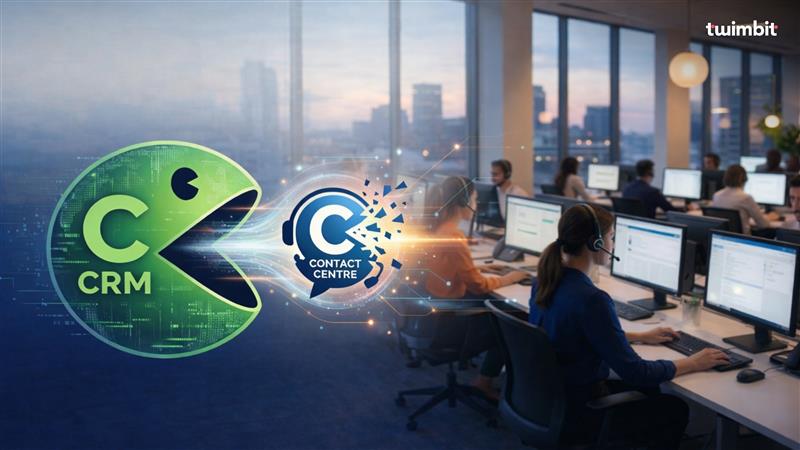
Is CRM eating the Contact Centre?
March 12, 2026

.svg)
.svg)


Blogs

Shivanu Shukla


For the better part of two decades, enterprises built customer service operations on a structural assumption: the CRM holds the truth about the customer, and the contact centre platform handles the conversation. Salesforce, Microsoft Dynamics, and SAP on one side. Genesys, NiCE, Cisco, Verint, Avaya and Five9 on the other. Connected through APIs, middleware, and significant consulting investment. This was an arrangement the industry accepted as the unavoidable cost of doing business or serving the customer.
With the recent announcement by Salesforce to launch its Agentforce Contact Centre offering, that assumption is now under serious challenge.
The CRM was designed as a longitudinal record: purchases, cases, preferences, sentiment over time. The organisational brain that knows who the customer is and what they mean to the business. The Contact Centre/CCaaS platform was built for the moment of interaction — routing calls, managing queues, measuring handle time, forecasting and recording for compliance. Both are genuinely excellent at what they were designed for. The problem has always been the seam between them.
Call it the architecture debt of a two-platform world. It shows up in middleware licensing, integration consultants, and engineering cycles spent keeping data synchronised whenever either platform updates. It shows up operationally when customer context arrives incomplete, and agents end up asking customers to repeat themselves. And in 2026, it shows up most critically as an AI performance ceiling.
When an AI agent handling a live interaction needs simultaneous access to purchase history, open cases, and real-time conversation data — but those assets live in separate systems — it’s working with a fractured picture. At the speed AI needs to operate, that’s not a minor inefficiency. It’s a structural limit on what AI-driven service can actually achieve.
The industry spent fifteen years engineering around this problem. AI has made it impossible to ignore any longer.
Agentforce Contact Center, launched at Enterprise Connect in March 2026, eliminates the seam rather than engineering around it. By building native voice, IVR, omnichannel routing, and a unified agent workspace directly within Salesforce, the company is making a clear strategic bet: in an AI-first world, the platform that owns customer data should also own the interaction and engagement layer.
It’s a bold move, but not a surprising one. Investments by Salesforce in Genesys already signalled the interest and intent that Salesforce had in the CCaaS space.
Salesforce building its own CCaaS solution means that it views CCaaS as a large adjacent opportunity that increases the stickiness and effectiveness of its CRM offering, and given its strong focus on AI, a CCaaS (system of engagement) + CRM (system of record) solution can be a massive AI growth catalyst.
While this development is a significant milestone for the industry, it would be unfair and premature to read Salesforce’s entry as the beginning of the end for CCaaS players such as NiCE and Genesys. These platforms carry thirty years of hard-won operational depth — workforce management forecasting, multi-jurisdiction compliance recording, outbound dialling across complex regulatory environments. That kind of institutional knowledge isn’t replicated in a product cycle or two.
NiCE and Genesys are also deeply embedded Salesforce partners. Both carry mature, certified integrations with Salesforce Service Cloud — giving enterprise customers a genuinely compelling architecture today: the richness of a purpose-built engagement platform, with full CRM data flowing into the agent desktop and AI layer. For many organisations, this isn’t a compromise. It’s a deliberate choice, and one that works well.
Where contact centre operations demand real complexity of delivery — global workforce management, multi-jurisdiction compliance, deeply customised routing logic — the specialist platforms hold a strong and defensible position, with or without Salesforce’s new ambitions.
The open question is how aggressively Salesforce chooses to push its CCaaS agenda. If Agentforce Contact Centre remains a credible option for mid-market and greenfield deployments, that’s a meaningful but manageable competitive incursion for the CCaaS players. If Salesforce begins to actively discourage CCaaS partnerships — through pricing incentives, platform restrictions, or preferential AI capabilities reserved for native deployments, then the calculus changes considerably. NiCE and Genesys will be watching that posture closely. So will every enterprise CX leader currently sitting across a contact centre renewal.
Zendesk, Microsoft, and ServiceNow are all moving in the same direction. The organising principle is consistent across all of them: the system that knows the customer should be the system that serves the customer natively, in a single data environment, with AI operating across the full arc of the relationship.
The architecture debt of the two-platform world was never really about middleware costs. It was about what became possible — and what stayed frustratingly out of reach — when customer intelligence and customer engagement lived apart. AI has made that gap both visible and urgent.
The organisations that close it most convincingly will define what great service looks like for the next decade. That race has well and truly begun.

.svg)






.svg)
