.svg)

Blogs
India’s Moment: Fix the Soil. The Seeds Are Already Top Notch.
March 26, 2026

.svg)
.svg)


Blogs

Chari TVT


The single most compelling proof of India's potential is this: Indians are running Google, Microsoft, Adobe, IBM, Twitter, and Mastercard – these are some of the world's most admired companies. The talent is extraordinary. The environment at home hasn't matched it. Yet. That is precisely what makes this the most exciting reform opportunity on earth.
India is not a nation in search of potential. It is a nation in the process of unleashing it. The last decade has produced genuine, world-class achievements across payments, space, pharma, and now artificial intelligence. Credit where it is due, and there is a lot of it.

India's UPI payments infrastructure is now being studied and adopted by more than 15 countries. India's space programme achieves remarkable results at a fraction of the cost that other countries spend billions on. India's pharmaceutical industry keeps the world healthy. And now India is making serious moves on AI compute and physical infrastructure. These are not consolation prizes. They are proof of what India does when the systems support the people.
Giving startups access to world-class compute at near-zero cost is exactly the kind of environmental fix this document calls for. It removes a real barrier, not a theoretical one. India should do more of this, and do it faster. The GPUs are there. The talent is there. The question now is whether the surrounding ecosystem, from IP protection to fast-track dispute resolution, can keep pace.
What the data tells us:
This is not a story about Indians lacking drive or capability. The IT sector succeeded in large part through body-shopping, helping other countries' brands become wildly successful. Indian engineers built America's tech industry. The question now is whether India will build the environment that makes it rational for that same calibre of person to stay, build, and own what they create.
Where the Friction Lives:
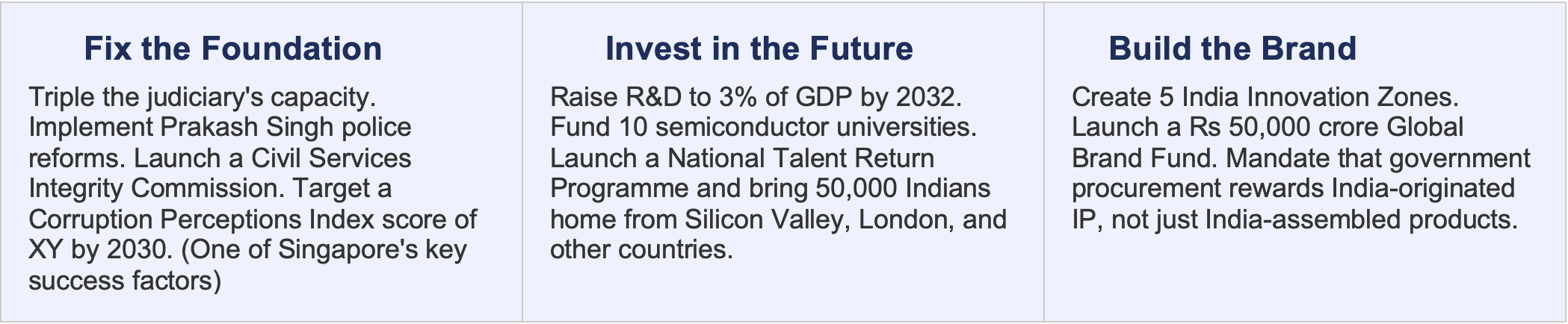
India does not need to invent a new playbook. Singapore cleaned up governance and became the world's most trusted business hub in a generation. South Korea backed deep-tech champions and built Samsung, Hyundai, and SK Hynix. Germany protected its Mittelstand and built 3.5 million globally competitive SMEs. India's turn is now and its scale means the impact will be global, not just national.
Learning from China: Take What Works, Leave What Doesn't
China's economic rise is the most rapid transformation in modern history. In 40 years it went from subsistence agriculture to the world's manufacturing powerhouse, now leading in electric vehicles, solar, 5G, and increasingly in semiconductors. India does not need to admire it uncritically or fear it reflexively. It needs to study it with clear eyes.

The Healthcare Leapfrog Opportunity
India already supplies 20% of the world's generic medicines, hosts 2 million medical tourists annually generating $9 billion, and runs Ayushman Bharat, the world's largest public health insurance scheme, covering 550 million people. The path to global healthcare leadership is clear: move from generics to drug discovery, from medical tourism to integrated health innovation hubs, and from API (Active Pharmaceutical Ingredient) import dependency on China to domestic API sovereignty. The IT sector showed exactly how this transition works. Services first, then products. Healthcare is India's next $500 billion export story.
India's IT sector succeeded in large part because software is weightless. It crossed borders over fibre optic cables and bypassed India's infrastructure limitations entirely. The next wave, from semiconductors to EVs to advanced manufacturing to healthcare hubs to space technology, cannot bypass the physical world. It needs reliable electricity, enforceable contracts, uncorrupt regulators, and institutions that reward integrity over expediency. The good news is that India is building these, visibly and at pace. The honest news is that the pace needs to accelerate further.
Every single constraint named in this document is self-imposed and therefore self-removable. India's democracy is not a handicap. India's diversity is not a complication. It is the source of the pluralism that produces world-class thinkers. India's young population is not a problem to manage. It is the single greatest demographic dividend available to any nation on earth right now.
Indians have proven, in Silicon Valley, in London, in Singapore, that when the environment matches the talent, the outcomes are extraordinary. The GPU access move, the infrastructure push, the sovereign AI mission: these are signs that India is beginning to build that environment at home. Keep going. When the best of India builds India, the world will take notice and the talent will come back.

.svg)






.svg)
