Every Indian telco tells investors the same ARPU story: customers are choosing better plans because the product got better. Jio's June 2026 DRHP puts it exactly this way, attributing its climb from Rs 181.7 in March 2024 to Rs 206.2 in March 2025 and Rs 214.0 in March 2026 to tariff repair, higher engagement, and consumers who perceive more value in higher-denomination packs. [1][2] Most of that is true. It is not the whole mechanism. A meaningful share of the reported uplift is not consumers walking up the price ladder, it is operators quietly removing the lower rungs.
The distinction matters. Historically, tariff repair in India was loud and dated: Vi led in December 2019, Bharti in December 2021, and Jio broke rank to lead the July 2024 round, with headline increases of 10 to 27 percent. [3] Analysts could model a step change every two years and the shape of the plan stayed the same, so the increase was legible. What has happened through 2026 is different in kind. There has been no formal industry-wide hike and headline prices on anchor plans have largely held, yet the effective cost of keeping a daily-data connection active has risen across all three private operators. The increase is being delivered through everything around the price: validity windows, data caps, and the existence of the cheap plan itself.
Three mechanisms, all of which read as premiumisation in a results deck
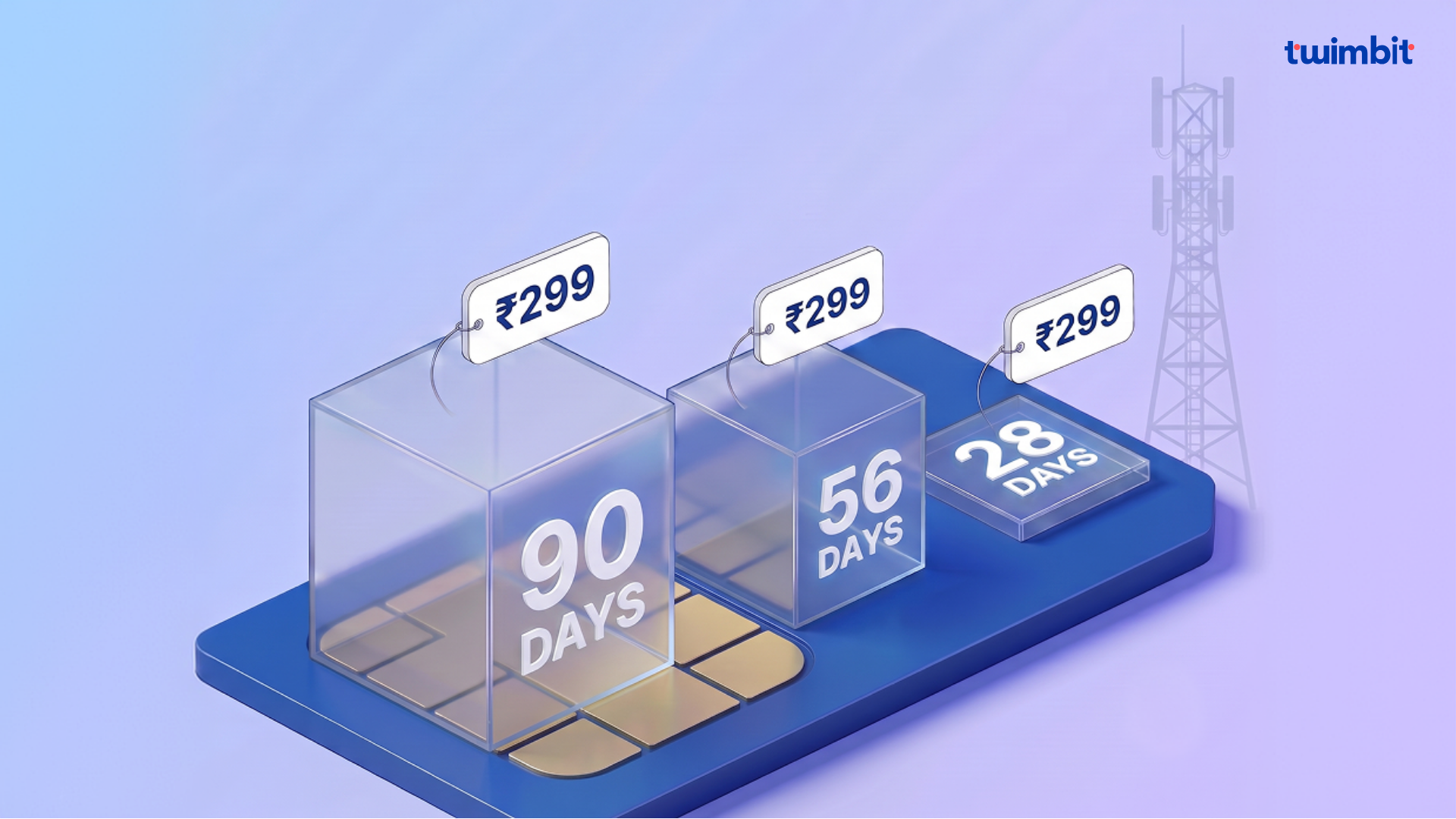
Validity compression is the purest shrinkflation. Same price on the shelf, less product in the box, where the box is measured in days. Jio cut its Rs 195 pack from 90 days to 30 days with the data allowance untouched, so the customer now recharges three times for what one recharge previously bought, with no announcement and no filing. [4] Airtel has done it structurally: its August 2026 revision removed the Rs 579, Rs 619 and Rs 799 plans at 56, 69 and 77 days, and the Rs 649 at 56 days. [5][6] What remains clusters on 28 days, which a sector analyst quoted in Business Standard noted looks a great deal like a postpaid billing cycle. [5] The arithmetic deserves attention: against a calendar-monthly baseline of 12 cycles a year, a 28-day base implies 13 recharges, which lifts annual spend before a single price is touched. That is close to a full hike's worth of revenue, extracted invisibly.
Deleting the entry rung is the more aggressive lever, because it converts a voluntary upgrade into a forced one:
- Airtel discontinued six prepaid plans in August 2026 (Rs 299, 319, 579, 619, 649, 799). The Rs 299 removal took out its last remaining 1GB per day plan, along with four 1.5GB per day options and one at 2GB per day. [5][13]
- The migration path is explicit and expensive. A Rs 299 customer on 1GB per day for 28 days is now directed to Rs 349 for the same 28 days, a 16.7 percent increase with no tariff hike announced anywhere. [13]
- Jio quietly removed its Rs 209 plan in May 2026, its cheapest 1GB per day tier at an effective Rs 9.50 per day, shortly after TRAI restricted app-exclusive tariffs. When the regulator closed a discount channel, the operator withdrew the low-margin product rather than extending the discount. [7][8]
Benefit downgrades are the third lever, and Vi has run it hardest. Rather than cutting days or killing plans, Vi downgraded a set of NonStop Hero plans carrying unlimited data (Rs 696, 795, 979, 994, 996, 998, 1198) to capped Hero Unlimited plans in select circles, at unchanged prices. [9] Between them, the three operators are now pulling every available lever: price per day, days per recharge, and gigabytes per day.
Note what Jio and Airtel have in common: both removed an entry-level 1GB per day tier within a year of each other, in a three-player market. That looks more like a market-structure outcome than a portfolio decision.
What it means for the retail user
- Effective cost is rising faster than any price list suggests. The numerator holds while the denominator, in days or gigabytes, shrinks. Nobody comparison-shops on cost per day, so the increase lands unnoticed.
- The cheap tier is disappearing across all three operators at once, removing the competitive escape hatch. A light user wanting 1GB a day under Rs 250 no longer has a private operator to port to, which neutralises the discipline mobile number portability was meant to impose.
- The burden falls hardest on those least able to absorb it. The withdrawn plans served students, gig workers, second-SIM holders and rural low-ARPU customers. Jio's DRHP concedes the risk directly, flagging that increases may face resistance in price-sensitive segments and push customers to lower-value plans or out of the base. [1]
- Recharge frequency itself is a cost. More recharges mean more friction, more lapses, and more exposure to grace-period mechanics for customers on tight cash cycles.
- There is nothing to protest. A 20 percent announced hike draws headlines, political attention and TRAI scrutiny. A validity cut from 90 days to 30 days draws a Reddit thread. It is difficult to read that asymmetry as accidental.
Part of the story is genuinely organic
It would be lazy to treat the entire trajectory as engineered. Consumption is the strongest real force: Jio's per capita usage reached 42.3GB per month in the March 2026 quarter from 33.6GB a year earlier, and industry usage of roughly 25.7GB as of Q3 FY2026 is projected to more than double to 59.2GB by FY2031. [1] A customer burning 40GB a month does not need nudging out of a 1GB per day plan, they outgrow it. Bundling is the second and more durable force: once a plan carries JioHotstar, Netflix, cloud storage or an AI subscription, the customer stops evaluating rupees per gigabyte and starts comparing the package against the standalone cost of what is inside it, a comparison the operator wins. That is why bundled plans carry both higher ARPU and lower churn, and it is the one part of the story where the customer genuinely gets more for more. Third, roughly 263.5 million Indians were still on 2G in March 2026, and every migration to 4G or 5G is accretive without anyone being squeezed. [1]
So ARPU is running on two engines. One is consumption growth and bundling, sustainable and largely benign. The other is portfolio engineering, effective, fast, and finite. Operators lean on the second because the first alone does not deliver the quarterly cadence that investors, and in Jio's case an imminent listing, require.
Systematic repair is nowhere near finished
Anyone modelling flat tariffs is likely wrong, because Indian ARPU sits far below any reasonable benchmark. The Analysys Mason forecast in Jio's DRHP has mobile broadband ARPU rising from Rs 199.8 in FY2026 to Rs 326.4 by FY2031, roughly 64 percent, with explicit further upside. [1][2] More tellingly, benchmarking Indian ARPU against GDP per capita across global markets puts even Rs 326.4 below the implied level, meaning the operators' own commissioned research calls its bullish case conservative. [1] Realisation per gigabyte was about Rs 7.9 as of Q3 FY2026 against Rs 239.8 in the US and Rs 17.5 in China. India is not cheap by a margin one hike can close.
The question is the instrument, not the direction. Expect these in parallel: formal synchronised hikes returning (IIFL Capital pushed its assumption to late 2026 rather than removing it, and JM Financial has tied the Jio IPO to a roughly 15 percent hike); [5][10] continuous portfolio pruning running alongside them, since each revision permanently raises the floor; 28-day validity standardising market-wide for its invisible uplift; harder prepaid-to-postpaid migration, for which the 28-day convergence is the on-ramp; and segmented, usage-based pricing replacing flat unlimited plans, consistent with Airtel's stated position that heavy users should pay more and that unlimited data has distorted sector pricing. [5][12]
The bottom line
The DRHP is accurate on the destination and incomplete on the route. ARPU is going to Rs 326.4 and probably beyond, the headroom is real, and the consumption and bundling tailwinds are genuine. What the narrative understates is how much of the near-term climb is manufactured rather than earned. When a plan is withdrawn and the customer moves up, the operator books premiumisation; from the customer's side it is a price increase they were not consulted on and cannot avoid. Both are true, and only one appears in the investor materials. For modelling the sector, the tariff-hike calendar is now the wrong unit of analysis: the repair is continuous, not episodic, and much of it will never be announced. For anyone paying the bill, it is simpler. The bill goes up either way, it just stopped arriving with a warning.
.svg)


.svg)
.svg)






.png)



.svg)

.svg)
