.svg)

Blogs
The Confidence Layer of CX: Why Great Experiences Remove Uncertainty
August 17, 2026

.svg)
.svg)


Blogs
.jpg)
Divagaar Siva


You pay for breakfast using a QR code. The screen takes a little longer than usual to respond.
“Did the payment go through?”
You check your phone. The cashier checks the terminal. For a few seconds, neither of you is quite sure.
Nothing has technically failed. Yet the experience already feels uncomfortable. That small moment captures an overlooked part of customer experience. Customers want more than speed and convenience. They want to know what is happening, what has happened, and what comes next.
Welcome to the Confidence Layer of CX.
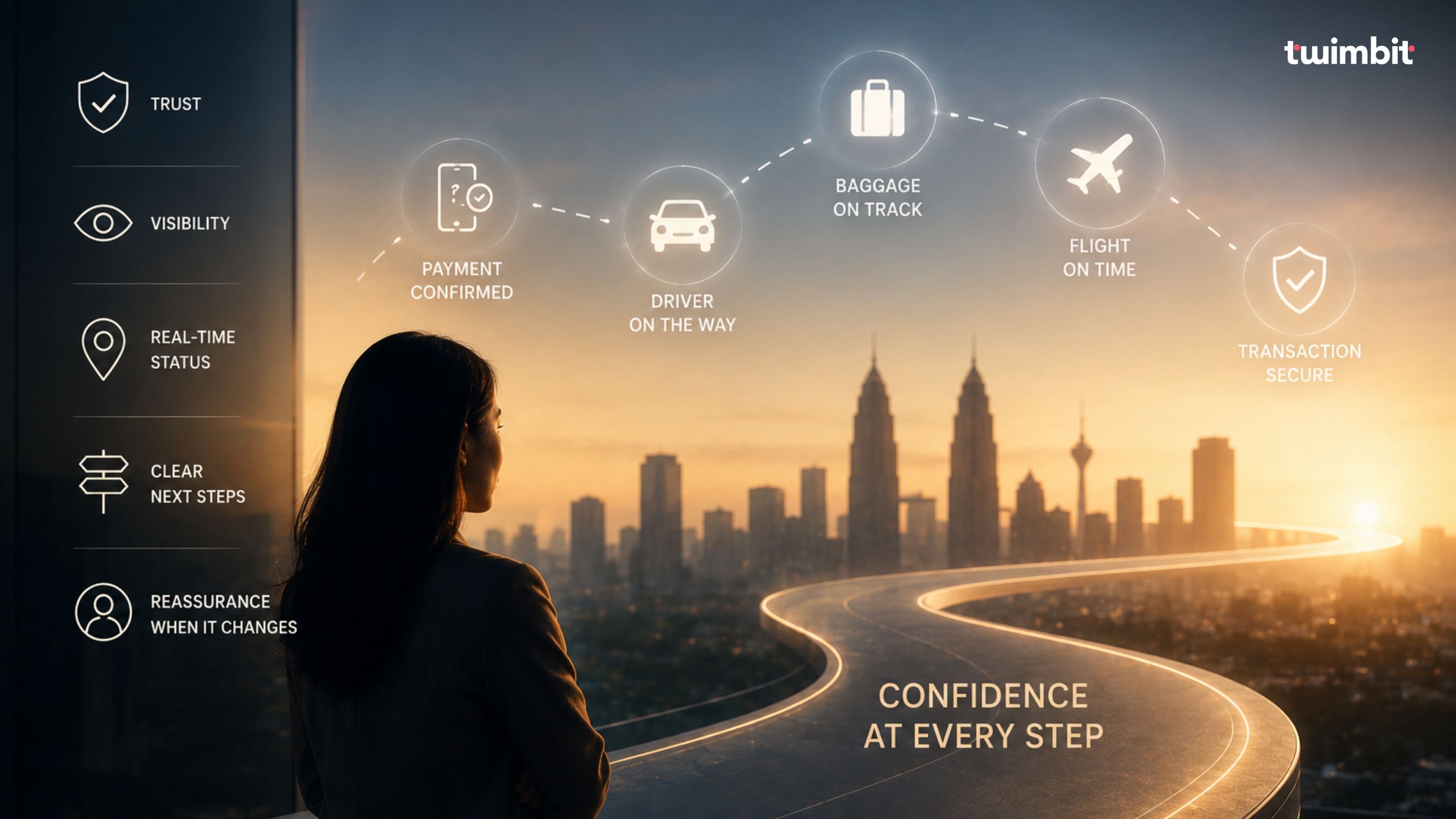
Digital experiences have removed many traditional points of friction. Payments happen in seconds. Rides are booked instantly. Flights can be managed through an app. Customer support is increasingly automated. But every invisible process creates another question for the customer.
“Was my payment successful?”
“Is my driver actually coming?”
“Where is my baggage?”
“Has my request been completed?”
Confidence comes from removing these small moments of doubt. Research founds that 63% of customers say their demand for greater transparency has increased compared with the previous year. This matters because an experience can be technically seamless and still create anxiety if the customer cannot see what is happening.
The strongest digital experiences provide certainty through four things:
Southeast Asia’s customers increasingly manage everyday life through digital platforms. Payments, transport, banking, food delivery and travel often happen within a few taps. The more services become invisible, the more important feedback becomes.
A customer should never need to refresh an app repeatedly, call support to confirm a request, or wonder whether a transaction has gone through. Confidence becomes part of the experience itself.
Touch ‘n Go eWallet, Malaysia
.png)
Touch ‘n Go Digital introduced its Soundbox devices to give merchants instant audio confirmation when QR payments are successful. The solution was designed partly to address fake payment screen scams and removes the need for merchants to repeatedly check customers’ phones. The experience is simple. A payment happens, the merchant hears the confirmation, and both sides know the transaction is complete.
Grab, Southeast Asia
.png)
Grab has expanded real-time journey visibility through Live Activities and Live Updates. Passengers can see their driver’s ETA, trip status, vehicle details and licence plate directly from their phone’s lock screen. Grab developed the feature after observing that users repeatedly reopened the app simply to check where their ride or delivery was. Making the status continuously visible reduces that need to double-check.
Singapore Airlines, Singapore
.png)
The SingaporeAir mobile app gives travellers live flight status, push notifications for delays or schedule changes, and baggage tracking during the journey. These features address some of the most uncertain moments in air travel. Instead of wondering whether a flight has changed or where a bag is, customers can see the status themselves and act accordingly.
DBS, Singapore
.png)
DBS has introduced stronger safeguards around high-risk transactions. Since July 2025, transactions to recipients identified as potentially high-risk can be rejected, with customers notified about why the transfer was stopped. The value is not only fraud prevention. Clear notification gives customers immediate certainty about what happened and what they should do next.
If confidence becomes a core part of experience design, CX leaders may need to look beyond traditional measures such as CSAT and response time.
Useful indicators could include:
The aim is simple. Customers should spend less time wondering.
Confidence needs to be designed into the journey.
Three principles matter:
The technology behind an experience can be sophisticated. The experience itself should feel certain.
Customer experience has become more silent, more agentic, more predictive, more autonomous, more trust-driven, and increasingly more capable of remembering customer context.
Each layer removes a different kind of customer effort. Confidence addresses another one. Doubt. Because customers should not have to wonder whether the system worked, whether someone is coming, whether their money is safe, or what happens next.
Great CX leaves customers with something simple. The confidence to move on.

.svg)


.jpg)


.svg)
