.svg)

Blogs
The 5G Payback
How fixed wireless became telecom’s fastest cash engine, and why the window will not stay open everywhere
How fixed wireless became telecom’s fastest cash engine, and why the window will not stay open everywhere
August 3, 2026

.svg)
.svg)


.png)
Blogs
How fixed wireless became telecom’s fastest cash engine, and why the window will not stay open everywhere

Sanskar Rathee


In the first quarter of 2026, the three largest operators in the United States added almost a million fixed wireless connections between them, and according to Ericsson’s Mobility Report they have now taken the majority of all broadband growth in that market for sixteen consecutive quarters. What makes that remarkable is where it is happening, in a country with near-universal cable coverage, where nearly every home already had a perfectly serviceable broadband option long before fixed wireless arrived.
Eight thousand miles away, JioAirFiber crossed 14 million subscribers and drove more than three-quarters of Jio’s 8.6 million fixed broadband additions over twelve months, in a market where most households have never had fixed broadband of any kind.
The same product is solving opposite problems in those two cases, and yet the financial logic underneath them is identical. That logic is what this piece is about, because fixed wireless access is routinely written up as a coverage story, a digital inclusion story or a rural story, when it is really none of those things. It is a returns story, and arguably the most attractive one available to a telecom operator today.
The thesis can be put in a single sentence.
FWA sells unused radio capacity at home-broadband prices, and spends nothing until a customer has signed.
That holds whether the customer had no broadband at all or was simply overpaying a cable company for it. The demand driver changes from one market to the next, but the profit and loss mechanics do not, and everything that follows is an elaboration of that single line.
The capex already happened
Operators spent the better part of a decade building mid-band 5G and received remarkably little consumer ARPU uplift in return, because faster phones did not translate into higher phone bills. Jio ended June 2026 with approximately 285 million 5G subscribers, an enormous and largely under-utilised asset that had no premium product attached to it.
FWA is the retrofit business case for all of that spending. The towers are already built, the spectrum is already licensed and the backhaul is already in the ground, which means off-peak capacity that was previously worth nothing becomes a saleable product at close to zero incremental network cost. The business case for 5G was never really found in the mobile plan; it was found in the living room.
You stop selling to a person and start selling to a household
Mobile is a per-person product with per-person economics, whereas a single FWA connection serves everyone under the roof and prices accordingly. Jio’s blended mobile ARPU sits at ₹215.6 while its AirFiber plans start at ₹600, a multiple of 2.8 times at the entry tier alone, before bundling and higher speed tiers pull the realised figure further up. Airtel’s pricing starts at the same point. One FWA line therefore carries roughly the revenue of three SIMs at a fraction of the incremental cost of serving them.
The second-order effect matters more than the first. Household products churn far below mobile, because leaving requires someone to physically come to your home, and the connection becomes the anchor for everything else the operator wants to sell, from content bundles to security services to additional lines.
The marginal cost is a router
Fixed broadband was historically telecom’s margin drag, built on heavy, slow-depreciating assets sold into price-competitive markets. FWA inverts that relationship, because the incremental cost of one more customer is a piece of customer premises equipment and an installation visit, and the underlying economics keep improving as per-bit delivery costs fall by roughly 40% in the move from LTE to 5G New Radio.
The segment-level evidence is already visible in the numbers. Airtel’s Homes business grew revenue by 25.7% year on year on record customer additions, in a quarter where its mobile business grew at a fraction of that rate.
Fibre spends and then hopes, while FWA sells and then spends
This is the pillar most commentary misses, and it is the one that justifies the word engine.
Fibre requires capital before it earns anything, since the cost per home passed is incurred against uncertain take-up and payback typically runs four to seven years. FWA reverses that sequence entirely, because nothing is spent until a customer signs, and what is spent amounts to a router and a share of radio capacity. The money goes out after the revenue is secured rather than years before it, payback compresses from years into months, and most importantly a market that fails costs an operator a warehouse of routers rather than a network it cannot un-build.
Unit economics: the shape of the difference
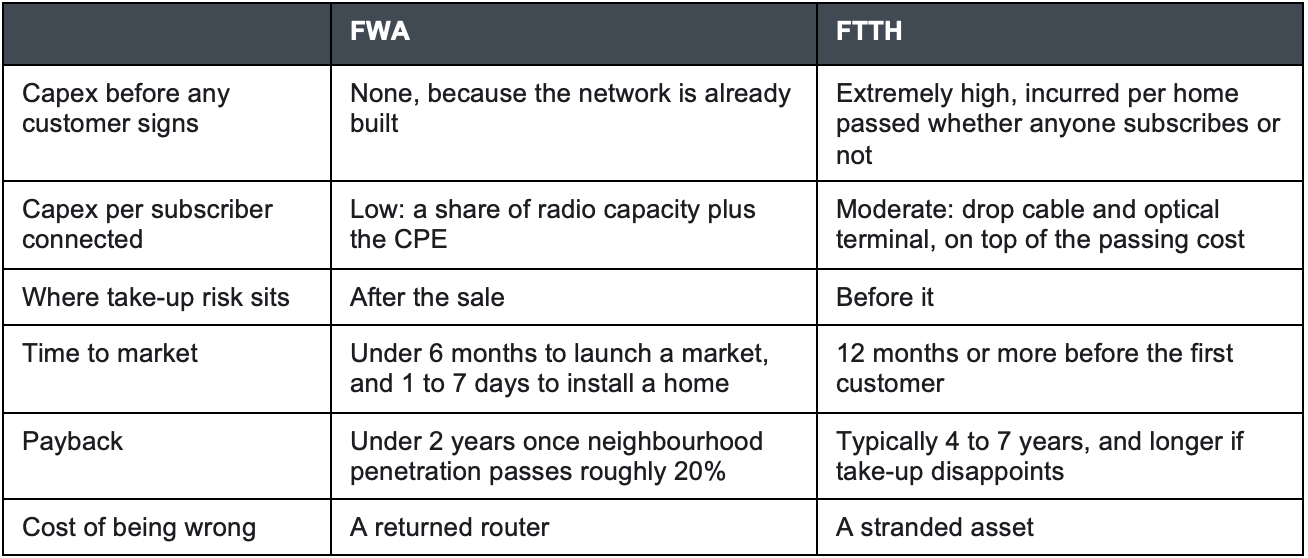
Mordor Intelligence puts the capital intensity gap between the two at roughly five to ten times, and the pattern travels well beyond Asia, with South African, Mexican and Brazilian carriers applying the same logic to leapfrog copper. One honest qualification belongs here, though, because it is routinely omitted from the sales pitch, which is that FWA is not cheaper on every line. GSMA’s work on FWA economics notes that while maintenance and go-to-market costs fall, site rental, power consumption and spectrum licence fees can push FWA’s operating expense above that of FTTx. The advantage is decisively in capital and in timing rather than uniformly across the profit and loss account.
The right-hand column explains why fibre rollouts are debated at board level for years, and the left-hand column explains why FWA rollouts are not.
Globally, Ericsson counts 185 million FWA connections at the end of 2025, rising toward 350 million by 2031, and more than 116 operators now sell commercial 5G FWA. Three of them show what the model looks like when it works, and they do so for three entirely different reasons.
Reliance Jio is the scale proof. AirFiber has taken the group’s total fixed base to 28.6 million subscribers and better than 43% market share, achieved in a fraction of the time any fibre build would have required. Three out of every four new home broadband connections Jio now adds arrive over the air rather than over glass, which makes fixed wireless not a supplement to its fibre business but the primary engine of it.
Bharti Airtel is the discipline proof. The company runs FWA and fibre in parallel rather than treating them as alternatives, adding roughly 1.6 million fibre home passes in a single quarter while aggressively expanding FWA into geographies where home-pass economics simply do not work. The FWA base extends the fibre franchise rather than replacing it.
Surge in Indonesia is the challenger proof, because it is not an incumbent telco at all. It secured spectrum, built on more than 50,000 existing neutral-host towers it does not own, and went to market at roughly US$6 a month for 100 Mbps uncapped. If the model works for a company renting almost every input it uses, the incumbents have little excuse.
There is one distinction that determines whether FWA is a five-year story or a fifteen-year one.
In developed markets, every FWA subscriber is subtracted from a cable or fibre operator. In Asia-Pacific, most are added to the broadband market itself.
The first of those is share capture with a hard arithmetic stop, while the second is category creation.
The developed-market ceiling is already visible. US carriers are competing for a finite pool of broadband households, and New Street Research sizes their combined FWA capacity at roughly 32 million subscribers against a current base near 17 million, which is a numerator with a known denominator and therefore the definition of a ceiling. The taper has already begun, with Verizon’s annual net additions falling from 1.5 million in 2024 to 1.1 million in 2025. A quieter signal points the same way, in that T-Mobile, the category’s global leader, has stopped reporting specific fixed wireless subscriber numbers and moved to an accounts basis instead, and when a company makes its flagship growth metric harder to track, that is itself information.
Asia-Pacific presents the opposite problem. India has roughly 46 million broadband households out of more than 300 million, which is around 15% penetration, while Indonesia sits near 25%, the Philippines below 40% and Malaysia at barely half of premises. Regional FWA connections are forecast to triple over the period ahead, taking Asia-Pacific past 45% of the global total by 2029.
The chart below makes the point visually. In Korea, the United States, Japan and Australia the unserved sliver is negligible, which means FWA can only ever take share from an existing wire. Across emerging Asia-Pacific the unserved block is the majority of the market, and that orange space is not a competitive battleground but empty territory. How much of it FWA can actually occupy is a separate question, and one the arithmetic later in this piece answers less generously than the chart implies.

The runway is therefore longer in emerging Asia-Pacific, though it is not unbounded, and it is worth being precise about what bounds it. FWA everywhere is squeezed from above by fibre, with Airtel adding roughly 1.6 million home passes a quarter and Surge passing 1.5 million premises alongside its wireless build, and from below by LEO satellite, which attacks exactly the sparse rural households that form FWA’s long tail. Between those two pressures sits the constraint that matters most, and the one most commentary gestures at without ever measuring, which is the capacity of the mobile network itself.
Before measuring that constraint, it is worth setting down an honest ledger of everything else that can go wrong, because the machine has stalled before.
The Philippines already ran the experiment. Globe reported 2.4 million FWA subscribers in the first quarter of 2022 and 1.2 million a year later, and then stopped reporting the number altogether. By the first quarter of 2026 its results mentioned fixed wireless exactly once, as the gradual tapering of legacy fixed wireless, using the word operators reserve for copper and SMS. Fibre rose from 87% of Globe’s home broadband revenue in 2024 to 93% by March 2026, and the mass-market segment FWA once owned now runs on prepaid fibre instead. The window there closed not because capacity ran out, but because Converge built fibre faster than anyone expected.
Payback is a direct function of device cost. Airtel Africa’s leadership has publicly flagged rising chipset costs, and a hardware price shock does not merely affect new additions, because it lengthens payback retroactively across the entire installed base.
The whole thesis also rests on cheap spectrum. Where mid-band was acquired at auction for large sums, the capital is not sunk in any useful sense but is instead debt, and FWA is servicing it rather than harvesting a free asset. The sharpest version of this bear case comes from MoffettNathanson’s Craig Moffett, who argues that FWA earns comparatively little revenue against the bandwidth it consumes and that the same spectrum may be worth more later serving autonomous vehicles or AI workloads. Every FWA subscriber is, on that reading, a bet that home broadband is the highest-value use of that capacity for the next decade.
All three risks are real, but they orbit a more central one, which is the question of how much FWA a mobile network can actually carry. That question is not merely real, it is calculable.
The question every operator should be able to answer, which is how many homes per cell before you stop, is estimable, and it is worth estimating even crudely, because the two constraints that govern it bind differently in different markets.
The first constraint is physics. A mid-band 5G sector on 100 MHz delivers roughly 1 Gbps of usable busy-hour throughput, and if 40% of that is allocated to FWA while mobile traffic retains priority, the question becomes how much each home actually draws at peak. Indian operators were reportedly taken by surprise on this point, because FWA homes consume between 500 and 600 GB a month against 250 to 300 GB for fibre homes, which works back to something closer to 5 Mbps of sustained busy-hour demand than the 4 Mbps a planner might assume. On that basis a sector carries around 80 FWA homes and a three-sector site around 240. Vary the spectrum depth and the intensity of household usage and the band runs from roughly 40 to 110 homes per sector. This ceiling is not theoretical, since Opensignal’s analysis of Zain in Saudi Arabia found that in areas of high FWA subscriber density, performance degraded for FWA and mobile users alike. Commercial success is what breaks the product.
It is worth pausing on an apparent contradiction there. Households buy plans rated at 30 to 100 Mbps while the model budgets 5 Mbps sustained, and both figures are correct, because operators sell peak burst and provision for statistical average at an oversubscription ratio somewhere between six and twenty times. That ratio is what makes the economics work, and it also locates the failure mode precisely, since FWA does not break when too many homes attach to a sector but when too many of them stream at the same time.
The second constraint is economics, and this is where the two clocks truly separate. Take India as the worked example, at a blended FWA ARPU of about ₹700 a month, given that entry plans at Jio and Airtel start at ₹600 and that tiering and bundling pull the realised figure higher.
What a full sector earns, and what the next one costs
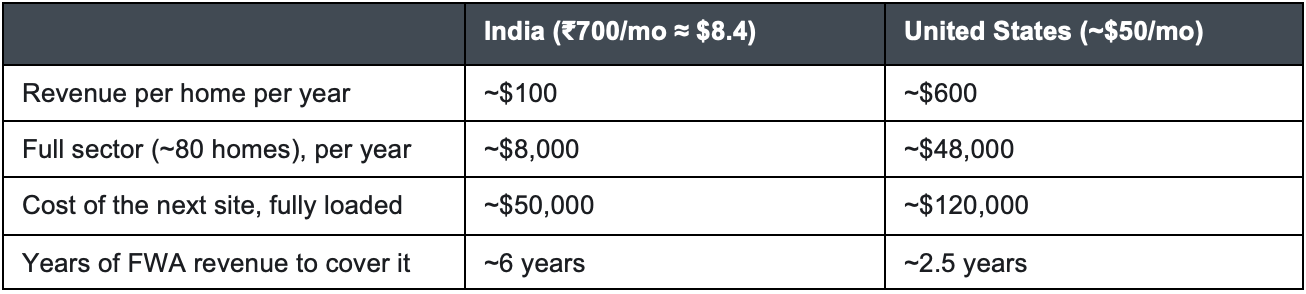
When a sector fills, the next unit of capacity is a new site or a small cell. A US operator earning around $48,000 a year from a full sector recovers that outlay from FWA revenue alone in about two and a half years, whereas an Indian operator earning a sixth of that needs roughly six, and the same arithmetic holds across emerging Asia-Pacific, where ARPUs cluster near India’s rather than America’s. That does not mean new sites never get built in those markets; it means FWA is never the reason they get built. Capacity in emerging Asia is funded by mobile demand and FWA rides on whatever is left over, which makes its growth dependent on somebody else’s investment case.
The intuitive assumption is that once FWA has to fund its own capacity, its economics converge toward fibre’s. In India they do not, and the reason is that Indian fibre is exceptionally expensive to build. EY has estimated the construction cost of reaching a fibre household there at around $1,580, among the highest in the world, against $200 in China, $307 in Thailand, $334 in Indonesia and $432 in Malaysia, with the gap driven by right-of-way charges, long approval lead times, uncooperative building societies and a fragmented construction industry. Even allowing for material unit cost reductions as Jio and Airtel have built at scale, a working figure of around $900 a home leaves fibre several times more expensive than FWA, whose per-home capex sits near $210 once a share of a new site is amortised across the 240 homes that site adds. Inside Towers, testing a next-generation fixed wireless platform against FTTH, found initial FWA capex under a tenth of fibre’s and thirty-year total cost of ownership at roughly a quarter.
So the limit on FWA in a dense Indian city is not cost at all. It is reach. A site that can serve 240 homes sits in a footprint containing several thousand of them, which means that however good the economics look, FWA can only ever pick up a fraction of any dense neighbourhood. The technology does not lose the cost argument in Mumbai; it simply cannot answer the question being asked there.
Where FWA can and cannot carry the load
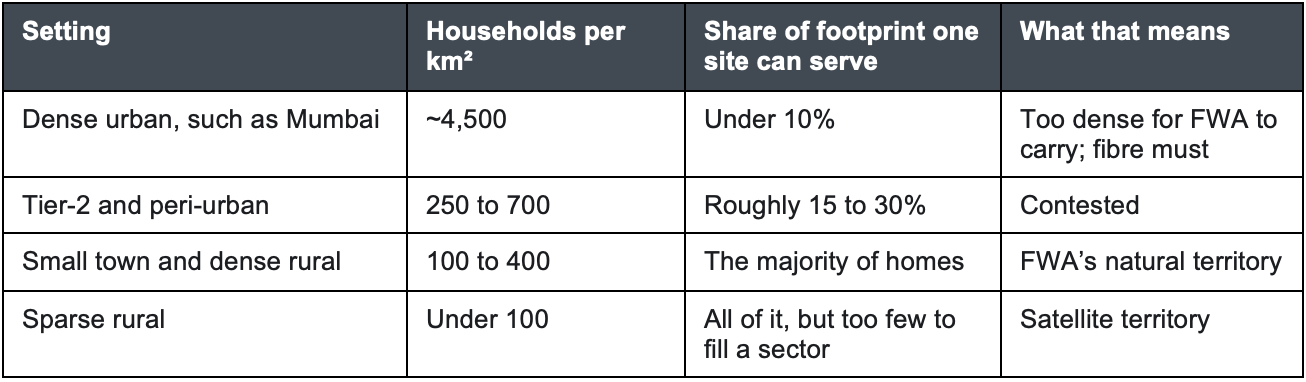
Read across that table and the shape of the opportunity becomes much more specific than the headline penetration numbers suggest. The unserved households in emerging Asia-Pacific are real, but a large share of them sit in cities too dense for fixed wireless to serve at scale, and another share sit in country too sparse to fill a sector. What is left, the band running from small towns through peri-urban fringes to dense rural clusters, is where FWA does its work, and it happens to be exactly the geography where fibre construction costs climb fastest.
In the United States, operators can afford to build more capacity for FWA but are running out of homes to sell it to. In India the homes are limitless, yet at these prices FWA will never pay for a new cell site on its own. So FWA grows only while there is unused capacity on towers that mobile has already paid for, and when that runs out growth stops, not because demand ended but because the arithmetic did.
Fixed wireless is not a new idea. Operators have been selling broadband over radio since the 1990s, and it failed every time for the same reason, which is that it needed its own spectrum, its own network and therefore its own business case, and the numbers never cleared. What 5G changed is not the concept but the arithmetic. Mid-band spectrum bought and built for mobile turns out to carry home broadband at a fraction of LTE’s cost per bit, from towers already standing, on capacity already paid for. The opportunity did not so much appear as the economics tilted toward it. That is why any operator holding mid-band spectrum should be looking hard at this, because the asset sits on the balance sheet whether it is monetised or not, and FWA is the only way to sell it twice.
The strategic question, then, is no longer whether to launch FWA, because everyone has. It is narrower and considerably harder: how many homes per cell before you stop, and how long is your particular window? The arithmetic above suggests the answer is knowable, and that it differs by an order of magnitude between Dallas and Delhi. Most operators have not done the sum.
Read this way, Jio’s parallel fibre build stops looking like a hedge and starts looking like sequencing, with fibre designated for the dense clusters FWA can never carry. The opportunity in emerging Asia-Pacific is therefore narrower than the penetration figures imply, and more specific: it is the chance to monetise unused mid-band 5G capacity within a particular band of household density, rather than a general licence to win home broadband. India is also, on fibre construction costs, an unusually favourable case for that argument, and operators in Indonesia or Malaysia should run the same sums against their own numbers before assuming the answer travels.
Operators who treat FWA as a capacity-managed financial product, with a known ceiling and a deliberate successor technology, will convert the 5G supercycle into cash. Operators who treat it as a subscriber-growth race will run out of network before they run out of customers.

.svg)
.jpg)





.svg)
