.svg)

Blogs
Hybrid cloud and infrastructure: the new intelligence layer of enterprise architecture
December 18, 2025

.svg)
.svg)



Blogs

Avneesh Saxena

.jpg)
Shivam Setia


Not long ago, cloud and AI were discussed as parallel priorities inside enterprises. Cloud strategy revolved around questions of infrastructure placement, deployment models, cost optimization, and resilience. AI, meanwhile, often entered the conversation as a separate track focused on use cases, experimentation, and pilots that ran alongside core IT decisions rather than being shaped by them.
That separation no longer holds.
Hybrid cloud and AI have fused into a single intelligent cloud transformation layer that now underpins enterprise competitiveness. AI defines the value extracted from cloud platforms, while cloud infrastructure determines the pace, scale, and reliability at which AI can be deployed across the organization. One without the other no longer delivers sustained advantage.
For CEOs, CIOs, and CFOs, this convergence fundamentally changes the strategic question. The issue is no longer “Which cloud should we choose?” but rather “Which intelligent cloud architecture best amplifies productivity, resilience, and innovation across the enterprise?”
Somewhere along the way, AI did not simply move onto the cloud.
It reshaped what the cloud is expected to deliver.
A central theme of the Twimbit report is that the intelligent cloud is not emerging organically it is being actively designed. Four hyperscale’s are shaping this new architecture, each bringing a distinct perspective on how intelligence should be embedded into enterprise environments.
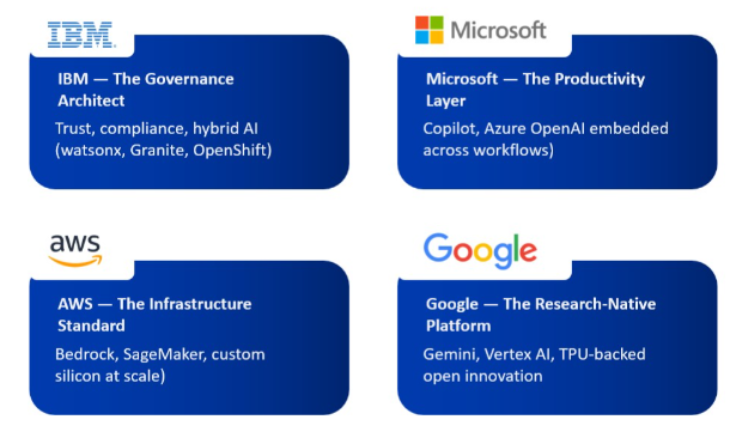
IBM is positioned as the governance architect, with a strong emphasis on trust, compliance, and hybrid AI. Through platforms such as watsonx, Granite, and Red Hat OpenShift, IBM focuses on enabling enterprises to deploy AI across hybrid and regulated environments without compromising governance or transparency.
AWS acts as the infrastructure standard, combining platforms such as Bedrock and SageMaker with custom silicon to transform AI into a high-performance execution engine. Its approach emphasizes scalability, modularity, and cost efficiency — enabling organizations to move AI workloads from experimentation into production at scale.
Microsoft operates as the productivity layer, embedding Copilot and Azure OpenAI directly into everyday enterprise workflows. Rather than treating AI as a separate system, Microsoft integrates intelligence into tools that employees already use, accelerating adoption and making AI part of daily knowledge work.
Google plays the role of the research-native platform, with Gemini, Vertex AI, and TPU-backed openness enabling rapid experimentation, personalization, and model evolution. Its strength lies in innovation velocity and the ability to translate advanced research capabilities into deployable enterprise services.
In this landscape, leadership is no longer defined by raw data-center capacity alone. It is defined by how deeply intelligence is woven into enterprise operations, workflows, and decision-making processes.
To help enterprises navigate these choices, the report proposes four dimensions for evaluating AI–cloud leadership.
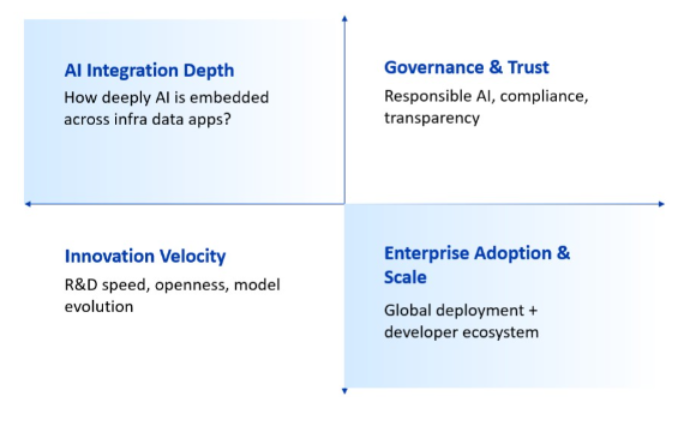
The report makes a critical point: the strongest platform is not necessarily the largest cloud provider. The right choice depends on how well a platform performs across these dimensions for an organization’s specific workloads, regulatory constraints, and transformation goals.
The analysis shows that hyperscale’s are already reshaping enterprise operations — not merely enabling AI initiatives in isolation.
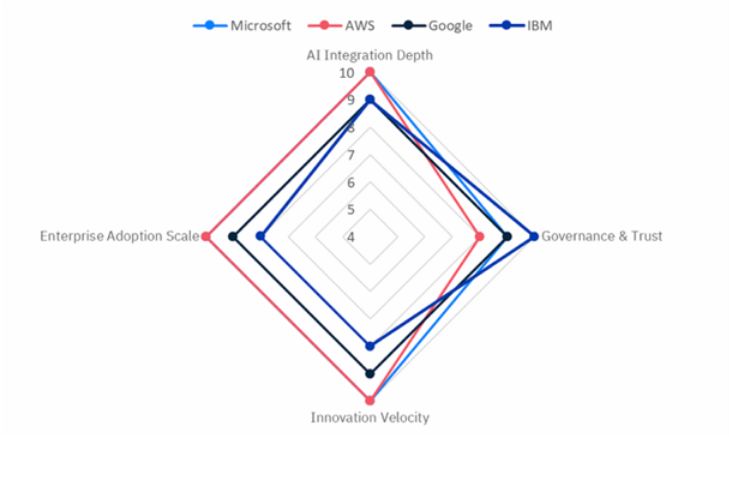
Hybrid, governed AI deployments are delivering measurable outcomes in regulated sectors such as healthcare and industrials. Copilot-style assistants are translating generative AI into daily productivity gains by augmenting routine work and accelerating content and decision workflows. Bedrock and custom silicon stacks are reducing the cost and latency of large-scale inference, making AI economically viable at scale. Gemini and open models are enabling rapid automation and personalization at customer engagement touchpoints.
As a result, impact is increasingly measured in workflow intelligence, cost leverage, and time to decision, rather than in the number of AI pilots or proofs of concept launched.
AI is no longer evaluated as a standalone technology. Its value is judged by how effectively it reshapes operations.
The report closes with a clear leadership mandate.
Intelligent cloud architecture has become the foundation of digital strategy, not an incremental IT upgrade. Enterprises must re-architect technology portfolios around deep AI–cloud integration, ensuring that intelligence is embedded into platforms rather than bolted on after deployment.
Responsible AI governance must be designed in from the outset, not retrofitted after scale is achieved. Platform engineering capabilities are increasingly critical, allowing organizations to abstract complexity for developers while maintaining consistency and control.
Multi-model and multi-cloud interoperability are essential to avoid new forms of lock-in as AI adoption accelerates. At the same time, building enterprise-wide AI fluency and automation skills is as important as any infrastructure decision.
For boards and C-suites, the message is unambiguous:
cloud strategy is now AI strategy, and organizations that treat them as one integrated conversation will set the pace for the next decade.
Connect to unlock exclusive insights, smart AI tools, and real connections that spark action.
Schedule a chat to unlock the full experience

.svg)






.svg)
