.svg)

Blogs
Discounts Win Indian Consumers. CX Keeps Them
January 16, 2026

.svg)
.svg)


Blogs
.jpg)
Mahek Rawat


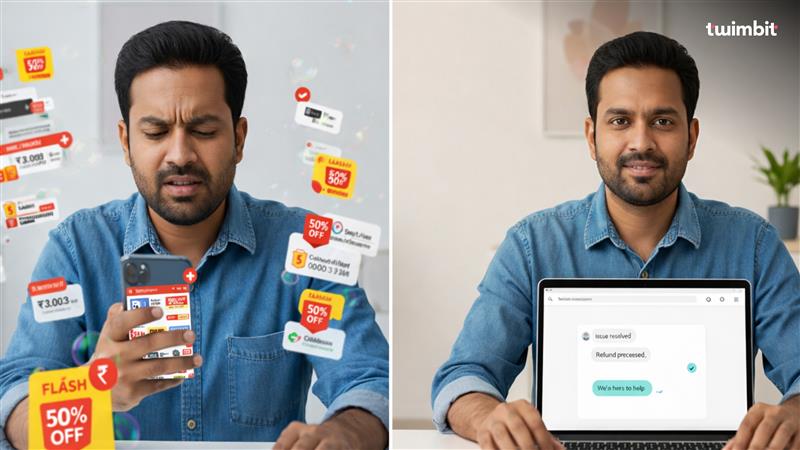
India is often described with a single, overused label: “price sensitive”. Open any shopping app during the festive season and the message is unmistakable: flash sales, cashback banners, and “lowest price guarantees” dominate the digital skyline.
The implicit belief behind these promotions is simple: Indian consumers care mainly about cost, so customer experience becomes secondary. Economic theory gives us a useful starting point. In markets where alternatives are plentiful and switching costs are low, demand becomes highly elastic. Indian e-commerce is a near-perfect illustration of elasticity in action: aggregator platforms allow consumers to compare sellers instantly, and a difference of even ₹50 can trigger brand hopping.
If consumers can switch brands as easily as they switch tabs, what exactly are Indian companies building, relationships or only transactions?
From an economist’s viewpoint, this behaviour is rational, consumers maximize utility by minimizing expenditure. But CX strategy cannot rely only on microeconomic rationality. Waiting time, effort, and frustration also have economic value.
Every extra click, every minute on hold, and every unresolved complaint increases the “real cost” of doing business with a firm. When patience itself becomes elastic, consumers may choose the cheaper option once, but they rarely stay loyal after a poor experience. The key idea here is that technology has lowered price-search costs for Indians, but it has not necessarily lowered consumer-effort costs.
Are Indian consumers truly price sensitive or are they effort sensitive in ways businesses fail to notice?
Most Indian businesses are built around winning the first transaction. They pour resources into performance marketing and onboarding offers, obsessing over Customer Acquisition Cost (CAC). Growth targets are framed in daily orders and gross merchandise value, while the long-term metric. Customer Lifetime Value (CLV) rarely receives equal attention. CLV is not a CX buzzword; it is a fundamentally economic measure representing the present value of future profit streams from a consumer. Yet many Indian firms behave as if consumers generate no future cash flows beyond the initial sale.
This short-term focus produces predictable outcomes: aggressive acquisition strategies followed by cost-cut support models. The paradox is clear; India’s companies optimize for growth today while ignoring the economics of retention tomorrow.
If Indian firms calculated the lifetime profit of a retained consumer, would they still treat support as an unavoidable expense?
To understand why CLV is neglected, we must talk about margins. India’s digital markets are brutally competitive and thin on profit. Logistics costs are high, returns are frequent, and support operations must serve users across languages and literacy levels. When margins per order are measured in single-digit rupees, every poor interaction creates a disproportionate economic impact. Economists would describe this as servicing costs exceeding marginal revenue; CX teams see it as something more practical, profits evaporating through refunds and replacements.
A single unresolved issue can erase the gains from multiple successful deliveries. Bad CX in India therefore behaves like a silent leak in a fragile economic model.
Behavioural economics helps deepen the argument. While surveys capture what consumers say they value, real behaviour reveals what they truly prioritize. These are known as revealed preferences. Indian consumers may claim that discounts drive loyalty, but their actions show a more nuanced hierarchy.
When risk is high, choosing a bank, booking a family holiday, or hiring a technician, consumers suddenly care far more about trust, transparency, and reassurance than about small price differences.
This is not irrational; it is economic logic shaped by involvement and perceived risk. In high-consideration categories, Indians pay premiums because superior CX reduces uncertainty and increases perceived fairness.
Are Indian consumers allergic to premium pricing or only to premiums that come without trustworthy experiences?
India behaves like a layered economy of experiences. In low-consideration categories such as fashion or groceries, elasticity dominates and price wars make sense. In high-stakes categories such as fintech, healthcare, education, mobility, and professional services, superior CX becomes a rational investment. Consumers return not because the brand was cheapest, but because the experience lowered anxiety.
Many Indian brands prove this daily, reliable mobility platforms, trusted banks, and professional home-service providers earn loyalty even when they are not the lowest priced.
Are Indian companies over-investing in fashionable technology while under-investing in human experiences that actually protect CLV?
Technology further complicates this relationship. Global CX playbooks celebrate AI chatbots and heavy CRM journeys, but Indian consumers live in a more frugal communication ecosystem, WhatsApp messages, quick callbacks, and vernacular conversations. Economic theory tells us tools create value only when they reduce real transaction costs. When automation replaces empathetic help with confusing bots, the effort cost rises instead of falling.
India will remain price conscious, that is a demographic and competitive truth. But price sensitivity does not make CX optional; it makes CX strategic. Superior experiences may not always allow Indian companies to charge more on day one, but they ensure that relationships become more valuable over time. Price wins the first transaction; CX wins the second.
Connect to unlock exclusive insights, smart AI tools, and real connections that spark action.
Schedule a chat to unlock the full experience

.svg)






.svg)
