.svg)

Blogs
CX Is Faster Than Ever. So Why Does It Feel Worse?
March 25, 2026

.svg)
.svg)


Blogs
.jpg)
Mahek Rawat


If you look closely, customer experience today feels different than it did a decade ago.
Not in an obvious way, but in how it’s designed. More and more, experiences are built for scale rather than for people.
Automation made that possible. Instant responses, automated flows, self-service everywhere.
From a business perspective, it works. But from a customer’s perspective, something is missing.
They’re getting answers. They’re just not always feeling understood.
That shift is reflected in a recent study conducted by Twimbit in partnership with Cisco Webex, where the top frustration with AI-powered support in India, cited by 44% of respondents, was lack of empathy or understanding.
Not accuracy. Not speed.
Empathy.
Automation excels at recognizing patterns.
A password reset looks like a password reset. An order tracking request looks like an order tracking request.
Machines love patterns. But customer interactions rarely arrive as clean patterns.
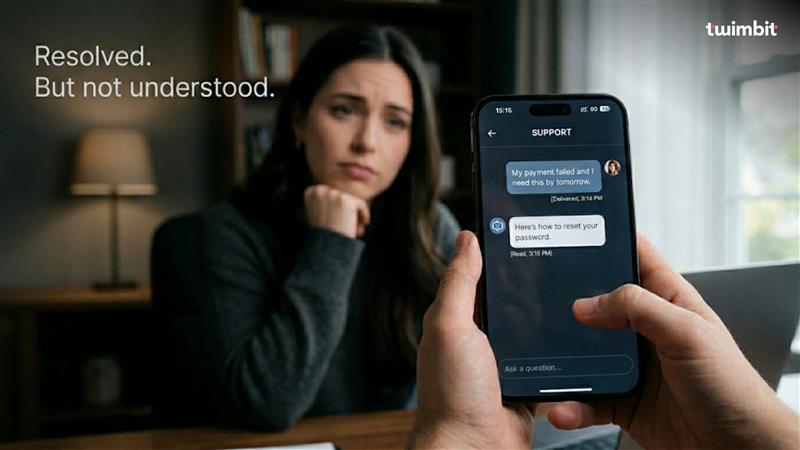
A message that says:
"My payment failed and I’m worried my order won’t arrive before tomorrow." is not just a payment issue. It’s a payment issue wrapped inside anxiety, urgency, and expectation.
Automation resolves the transaction. Humans respond to the emotion around it.
And that difference is where the empathy gap begins. Pause for a second:
Interestingly, consumers don’t reject AI. Their expectations are practical.
They want faster resolutions.
They want more personalized experiences.
They want problems solved before they escalate.
But they’re not asking for less human connection.
Most automation initiatives begin with good intentions.
Faster response times. Lower operational costs. 24/7 availability.
Then the metrics take over.
Containment rate. Ticket deflection. Cost per contact.
And slowly, the goal shifts.
From helping the customer to handling the interaction efficiently. It sounds subtle. But it changes how experiences are designed.
Because while companies ask:
“How many interactions can we automate?”
Consumers are asking something else:
“Why is it so hard to reach a human when something actually matters?”
Twimbit’s research across India and Southeast Asia finds that 42.5% of consumers prefer speaking to a live agent for all issues, simple or complex.
Even now. Even with automation everywhere.
Containment rate is often treated as success.
If the bot handles the interaction without escalation, it’s a win.
But what if the customer didn’t escalate because they gave up?
They closed the chat.
They abandoned the journey.
They decided it wasn’t worth the effort.
From the dashboard, it looks like success. From the customer’s perspective, it’s failure.
And the impact is real.
In Twimbit’s research for the Genesys Future of CX in Asia report, 68% of consumers said they stopped using a brand because of poor customer service.
Not price. Not product.
Experience.
It’s tempting to think better AI will fix this. Smarter bots. Better models. More automation. Those will help.
But the deeper issue isn’t capability. It’s design. Automation is often built far from the emotional reality of customer interactions. Engineers design flows. Teams optimize metrics.
But frontline agents understand something critical: Consumers don’t just want answers.
They want acknowledgment. They want to feel like someone understands why the problem matters.
The Question That Actually Matters
Automation is necessary. That’s not the debate. But when automation becomes the primary experience, something essential gets lost.
So maybe the real question isn’t:
“How much can we automate?”
Maybe it’s:
“Where should automation stop?”
Because some moments carry weight. Billing issues. Failed deliveries. Service disruptions. In those moments, consumers don’t just want speed. They want reassurance.
And reassurance rarely comes from a flow.
Before launching the next automation initiative, it may be worth asking a question that rarely appears in CX dashboards.
Not:
“How efficient will this system be?” But:
If you were the consumer inside your own automation flow, would you feel helped, or managed?
Because scalable CX is not just about how many interactions technology can handle.
It’s about how many human moments it can preserve.
Connect to unlock exclusive insights, smart AI tools, and real connections that spark action.
Schedule a chat to unlock the full experience

.svg)





.svg)
