.svg)

Blogs
AI is Changing the ERP Conversation
May 25, 2026

.svg)
.svg)


.jpg)
Blogs

Chari TVT


Salesforce: 25 years of dominance, $35.7 billion in revenue, 90% of the Fortune 500. A remarkable moat. But the more interesting question is not whether the moat is real. It is whether AI has just made it irrelevant.
If AI can now access, reason over, and act on enterprise data without requiring seats, migrations, or centralised platforms, the entire model shifts. And not just for CRM. For every system your Board has approved capital for in the last decade.
We spent years moving data to where the intelligence lived. Now the intelligence moves to where the data lives. That single inversion changes the economics of everything built on the old assumption.
THE CORE SHIFT IN AI-NATIVE DATA ARCHITECTURE
For two decades, the answer was the same regardless of industry: build a data lake. Extract from systems of record, transform into a common format, centralise, and have analysts derive insight. It was expensive, slow, and brittle. But it worked because AI could not reason across disparate systems.
That constraint no longer exists.
The cost of the old model was never just the technology. It was the assumption baked into it: that you had to consolidate before you could reason. AI has made that assumption optional. The enterprises still building around it are paying for a problem that has already been solved.
AI agents can now access structured and unstructured data directly across multiple systems, on demand, without physical movement. They do this through:
They retrieve only what is needed, reason over it in context, and surface insight without requiring data to be copied, transformed, or centralised first. Some replication still occurs at the caching and semantic layer. But the heavy, systematic movement of entire datasets that defined the old architecture is no longer the prerequisite it once was.
The enterprises that will win are not the ones with the biggest data platforms. They are the ones that can ask better questions, faster, and act on the answers before the moment passes.
ON COMPETITIVE ADVANTAGE IN THE AI ERA
This is not an infrastructure debate. Across every function, the shift from batch consolidation to governed intelligent access produces real differences in decision quality and speed.
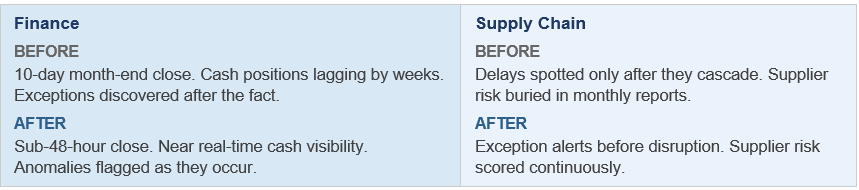
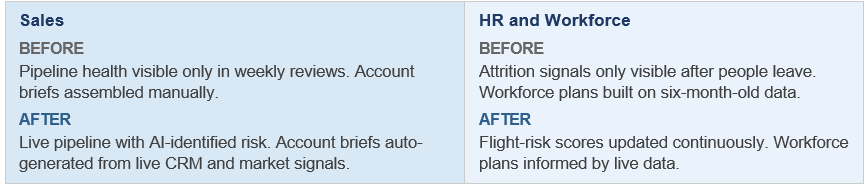
This is where the argument becomes genuinely disruptive — and where most Boards are making a very expensive mistake.
Enterprises across the world are mid-cycle on SAP S/4HANA migrations, Oracle Fusion rollouts, or Dynamics 365 transformations. The investment is enormous. The justification is almost always the same: we need a single, clean system of record to get better controls and better data.
That justification made sense in 2015. It deserves harder scrutiny today.
Your legacy SAP, Oracle, or Dynamics instance — however old, however messy — holds years of transactional history, vendor relationships, cost structures, and financial rhythms. That institutional memory is an asset. The problem was never the data. The problem was the inability to interrogate it intelligently.
An AI layer sitting above your existing systems of record can:
The controls get better. The visibility gets sharper. The close gets faster. And you do not spend three years and nine figures discovering that the implementation partner's definition of go-live differs from yours.
You do not always need a new system of record. You need a smarter system of context — one that reasons across the data you already have, in the systems where it already lives.
THE ERP ALTERNATIVE MOST BOARDS HAVE NOT YET CONSIDERED
The Two Paths
Conventional: Legacy ERP → Rip & Replace → 3-5 Year Programme → Better Controls? Maybe.
AI-Native: Legacy ERP (unchanged) → AI System of Context → Real Controls. Fast Close. Sharp Insight.
New investment should be directed toward intelligent access, not more centralised consolidation. Legacy platforms still hold real value for historical analysis, regulatory reporting, and model training. The question is: what are you authorising next?
01. Are we designing data strategy around consolidation, or around access?
The mental model your team works from matters as much as the infrastructure budget.
02. Do our governance frameworks account for AI agents operating directly across systems of record?
Most do not. This is not a technical gap. It is a board-level risk.
03. How much of our current data engineering spend is pipeline maintenance rather than insight generation?
The answer is usually uncomfortable — and usually the right place to start.
04. Is our ERP programme solving a data problem, or a data access problem?
If it is the latter, an AI-native System of Context may deliver better controls, faster closing, and sharper insight in a fraction of the time, at a fraction of the cost — without touching the underlying system of record.
This is not a technology upgrade. It is a fundamental rethink of how enterprises access, govern, and act on information — and the window to get ahead of it is narrowing.
FROM BATCH ETL TO AI-NATIVE INTELLIGENT ACCESS

.svg)






.svg)
