.svg)

Blogs
From pipes to compute: The AI value chain is the APAC telcos’ next non-connectivity play
October 8, 2026

.svg)
.svg)


Blogs

Sanskar Rathee


Ajay Sunder


The core is under pressure in mature and large markets alike. Singtel's revenue fell 3.1%. KT's wireless service revenue slipped 1.8%. China Mobile's communications services revenue fell 5.7% to RMB 350.4bn, partly because of a change in VAT scope. Telstra's problem is the slowest-moving and probably the hardest to reverse. Its fixed enterprise business income fell 8.1%, losing ground to "competition and technology change" in data and connectivity services.
But look at where the growth is coming from and you see a very different picture. Singtel's Nxera grew on the back of its DC Tuas facility, and RE:AI GPU cloud is scaling to 6MW by the end of FY27, already contracted at roughly S$600m. SK Telecom moved its data centres into SK Horizon in a partnership with KKR and an IMM-led consortium. IMM's infrastructure head described AI data centres and subsea cables as core assets for Korea's digital sovereignty, and that is how financial investors now see this layer.
China Mobile's computing services, which includes data centres and cloud, now makes up almost 12% oftheir core revenue, the company signed 5GW of new AI data centre contracts in the first half alone. Most of the region is in the same position: very high growth rates from a small base. This is why telcos need to make their next growth investment choice importantly.
When telcos first went looking for life beyond connectivity, fintech, streaming and gaming were the obvious places to start, with an existing customer base and billing relationship already in place. Now, almost every large operator in the region runs at least one of these businesses, and that is exactly the problem.
The APAC region's fintech success stories are real, and almost all of them were built on the back of a telco. Airtel Money, PayPay and Mynt each reached scale by riding the parent's subscriber base, retail footprint and customer relationships, a distribution advantage no standalone fintech could easily buy. Look closely, though, at how that value is now being realised. Airtel Money is heading for a London listing in the second half of 2026. SoftBank listed PayPay on Nasdaq in March 2026 at a valuation of US$14.7bn, one of the few fintech IPOs built on a business that is winning its domestic market. In the Philippines, Mynt is going through one of the country's largest IPOs, with around 80% of the offering made up of shares sold by existing owners rather than new money. Once these businesses pass a certain scale, the value is unlocked by separating them from the telco and bringing in financial institutions and investors to run them on their own merit. Fintech can be an excellent investment for a telco, but the payoff comes from incubating the business on the telco base and then listing the stake, rather than from an engine that keeps growing the telco's own topline.
Looking into content, there's a different ceiling it runs into. The telco's one structural edge, bundling a subscription into a mobile plan, is now standard across the market, so it no longer sets anyone apart. Gaming and lifestyle apps are crowded because most operators sell the same partner services. These services lift ARPU at the edges, but none of them can grow big enough to replace the core.
The best bet of real growth comes down to three things. Scalability, defensibility and a telco-native advantage.
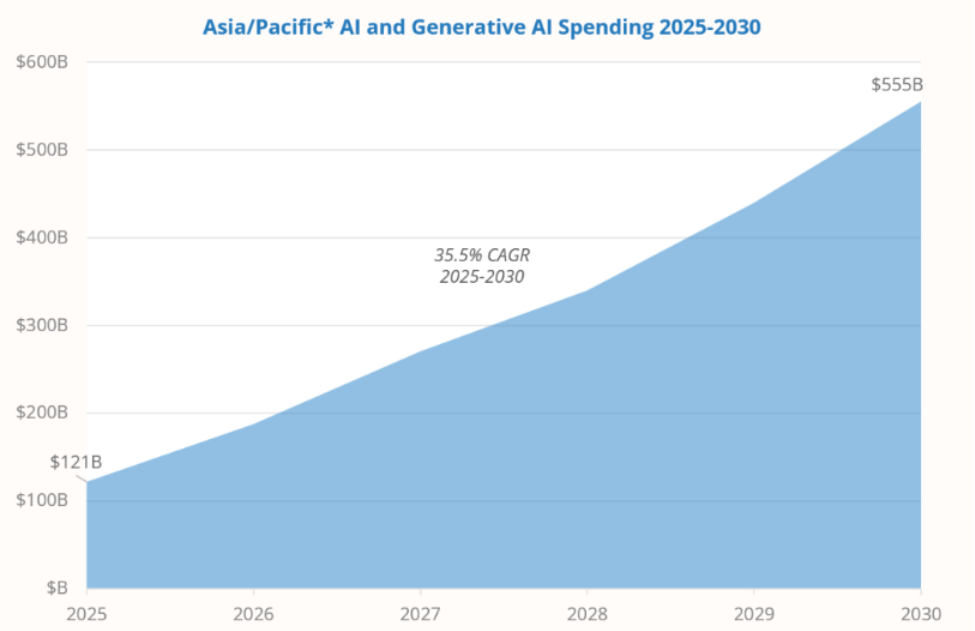
AI is no longer a line item inside IT budgets. It is turning into a spending category of its own, big enough to register at the level of national economies. IDC research puts worldwide AI spending at US$2.67tn this year, up nearly 50%, with infrastructure taking about 56% of the total. For Asia Pacific, a separate forecast expects AI and GenAI spending to grow from US$121.5bn in 2025 to US$555.2bn by 2030, with infrastructure about a third of that.
The clearest gap is in sovereign and regulated work. Airtel says its large cloud wins are sovereign deals, and that customers move slowly because of integration effort and egress fees. Global sovereign cloud spending is expected to reach US$80bn in 2026, yet mature Asia Pacific accounts for only US$1.6bn of it, growing at 87%. A small base growing that fast presents an opportunity.
Physical limits are now pushing demand outward in regions. Singapore's colocation vacancy fell below 1% in the first half of 2026. Johor, Malaysia, has vacancy of just 0.7% and has told water-cooled projects to wait until mid-2027. The next wave is moving to India, Indonesia and the Philippines. Globe CEO Carl Cruz told Bloomberg he expects AI to lift data traffic three to five times over the next couple of years. In India, Airtel plans to scale from 120–130MW towards 1GW, while Reliance is targeting 120MW at Jamnagar by the end of 2026, running on Nvidia's latest chips, powered by its own renewable energy from Kutch, and linked to Delhi and Mumbai through Jio's fibre network.
Each of these is a telco becoming the layer that the hyperscalers cannot easily build for themselves. Turning its land, power access and network into contracted capacity.
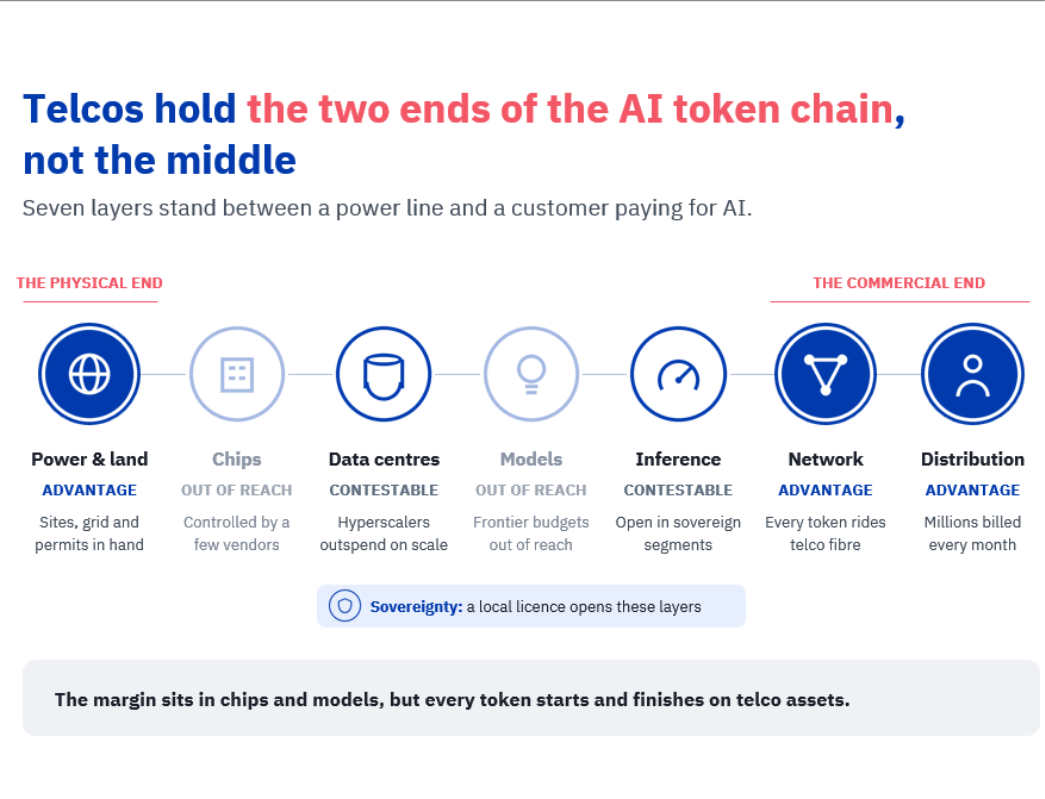
The AI value chain runs from land and power at the bottom, through compute and the networks that move data, up to the models, platforms and applications customers use.
APAC Telcos have an upper hand in three places:
The scarcest input in AI is not chips. It is land (with a grid connection and enough power behind it). KT is targeting an extra 1GW by 2031. Indosat's Zankore plans about 200MW of GB300 capacity in H1 2027 on the way to 1GW, backed by US$800m from Ooredoo. What matters here is contracting before building.
AI workloads have to move between data centres, across borders and out to users, making network a "part of the product". Telstra sold on more than half of its newly acquired subsea capacity and China Mobile now runs 437Tbps of international capacity. Airtel is building DC-to-DC links over fibre on power transmission lines. Here, the value comes from long-term capacity contracts with the companies building AI, rather than charging more per bit.
In May 2026, SK Telecom signed an agreement with Korea's Ministry of National Defence to build defence AI on the country's sovereign foundation model while Reliance is pitching sovereign hosting with AI built for 22 Indian languages. Research published by WEF argues that telcos acting as national sovereign champions can meaningfully improve their return on invested capital by using their local presence and close alignment with regulators.
Turning Position into Revenue Is the Hard Part
Owning the right assets is only half the job. The operators pulling ahead are the ones packaging those assets into products a customer can buy, and with Gartner expecting US$29bn to go on AI agents and assistants and US$28bn on generative AI models in 2026, the money is clearly moving up the stack. The path looks like a ladder, from colocation at the bottom, through GPU-as-a-service and managed AI platforms, up to sovereign and industry-specific solutions. Every step up pays better and is harder for a customer to walk away from, but it also asks more of the operator.
The rule here is to contract before you build. Singtel began selling RE:AI in January 2026 and had roughly S$600m contracted on its way to 6MW. GPUs lose value fast and every new chip generation reprices the last, so utilisation and contract length say far more about this business than announced capacity. That is also why the capital is changing shape, with KKR and an IMM-led consortium backing SK Horizon and Ooredoo putting US$800m behind Indosat's Zankore. Much like fintech, these businesses tend to be valued more highly when they stand on their own.
Today the network earns through long-term capacity contracts and AI-ready products such as NTT's distributed GPU network and Jio's network slicing. The bigger prize is still ahead. As AI shifts from training models to running them, inference is moving closer to the people and machines that use it, and that plays straight into what telcos already own: exchanges and tower sites with land and power behind them, fibre that reaches every town, and the trust of regulators who want data kept at home. A hyperscaler can build a giant campus outside a city, but it cannot easily recreate thousands of sites a few kilometres from every customer. At the edge, the strongholds stop being separate assets and start working as one product.
The money comes in two layers. Governments often fund the build, as with the GPUs Korea's national AI project supplies to SKT, and then become paying customers for defence and public-sector deployments. On top of that sit licences, on-premise installs and managed services for regulated industries, where NTT already has around ¥67bn in tsuzumi orders in a single quarter, roughly half of them from the public sector and finance in Japan.
Airtel's 12 months of Perplexity Pro and Jio's free Gemini Pro are powerful for retention, but they are not revenue yet. The Chinese operators are the exception, selling AI usage the way they once sold mobile data, with China Telecom offering 10 million tokens for 9.9 yuan a month and China Mobile running promotions of 400,000 tokens for 1 yuan, charged to the phone bill. The real question for the rest of APAC is how many of those free users will pay once the free year runs out.
None of this works without the right people to sell it. Telco sales teams were built to sell connectivity, while AI needs solution architects, industry use cases and integration partners who can turn raw capacity into something a CIO can actually deploy. This is where a lot of good assets quietly fail to become revenue.
Telcos have been here before. In the 2010s, many of the world's biggest operators sold their data centres and watched the hyperscalers take the cloud. This time, scarce power, sovereignty and inference at the edge all favour the operator, and the way to tell who is really using that advantage is to look past the announcements, at contracted against built capacity, utilisation, revenue per megawatt and the share of enterprise revenue coming from AI.
The clearest way to turn that advantage into revenue is to move from renting GPUs by the hour to selling tokens. When a telco rents out capacity, its only levers are utilisation and price, and every improvement in silicon, batching or caching eventually reaches the customer as a price cut. When it owns the stack and bills per token, those same gains land in gross margin, and the same GPU earns several times more over its life. Token-as-a-Service also fits how enterprises now buy AI: through production-ready endpoints with SLAs written in time-to-first-token and tokens per second, where agentic workloads keep the meter running long after a chatbot would have stopped. The climb runs from compute to a managed platform, then to per-token inference and fine-tuning, and finally to vertical solutions priced on the outcomes customers pay for, with margin improving at every step. For APAC operators, the real edge sits in the layer global neoclouds cannot easily copy: local-language models, local-currency billing and compliance built in for regulated sectors.
The Window Is Open, but Not for Long
For APAC telcos, this window will not stay open forever. The capacity contracts signed in 2026 will decide who hosts the region's inference workloads for the next decade, and once an enterprise has moved its models, its data and its people onto someone's platform, it rarely moves again.
The operators that act now will have something the industry has not seen in a long time, a second growth engine with real scale. The ones that wait might end up selling connectivity to data centres someone else built, which is a familiar position for telcos and not a profitable one.
Some APAC operators are already on this path, signing contracts, bringing in partners and putting their own models in front of customers. Others are still announcing capacity and hoping the demand follows. Over the next few quarters, the numbers will show which group each operator really belongs to, and the gap between the two may turn out to be far wider than anyone expects. From land and power to sovereign cloud and the edge, APAC telcos already own the assets AI needs. The real question is which of them can turn those assets into revenue before the window closes.
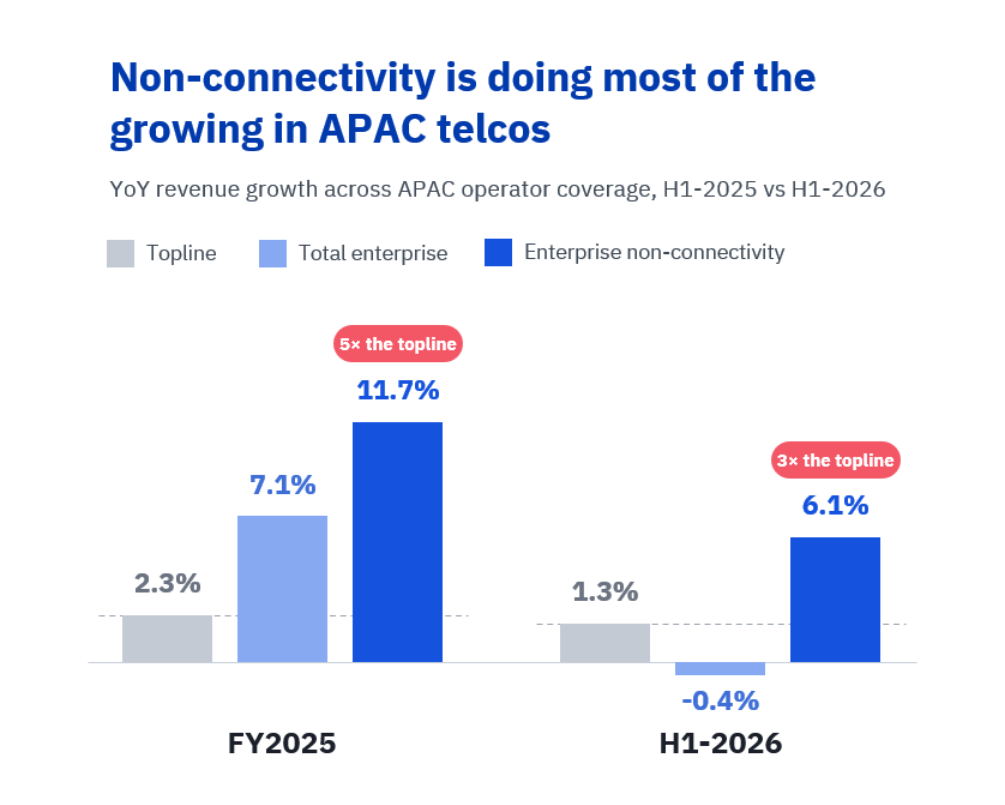
Most APAC telcos no longer debate whether to grow beyond connectivity. The harder question, and the one that will shape the next decade, is which parts of non-connectivity can grow fast enough to replace what the core is losing. Across some of the region's largest operators, combined revenue barely moved this year, edging up from US$195.7bn to US$197.6bn, and yet one small part of their business already makes up 17.2% of the topline. That part is enterprise non-connectivity, and the fastest-growing piece of it is AI infrastructure. PCCW, Bharti Airtel and SK Telecom grew this line while StarHub, Telstra and KT went the other way, each seeing it shrink by more than 13%. The gap between those two groups is where this story begins.
Non-connectivity is growing while the core is shrinking.

.svg)





.svg)
