.svg)

Blogs
Great CX is not what we do. It is who we are.
October 6, 2026

.svg)
.svg)



Blogs

Manoj Menon


My Japanese colleague had the cleanest desk in the office. It was also the least busy. At the end of every day, everything was in its place, as if no one had been there at all.
Nobody asked him to do it. Nobody was checking. It was simply who he was.
I have been thinking about that desk, because today is CX Day, and it has made me question how most of us talk about customer experience.
Who owns customer experience in your company? Most of us would point to a team, a dashboard or a score. I have come to believe that answer is the problem. Great CX is not something a company does. It is something a company is.
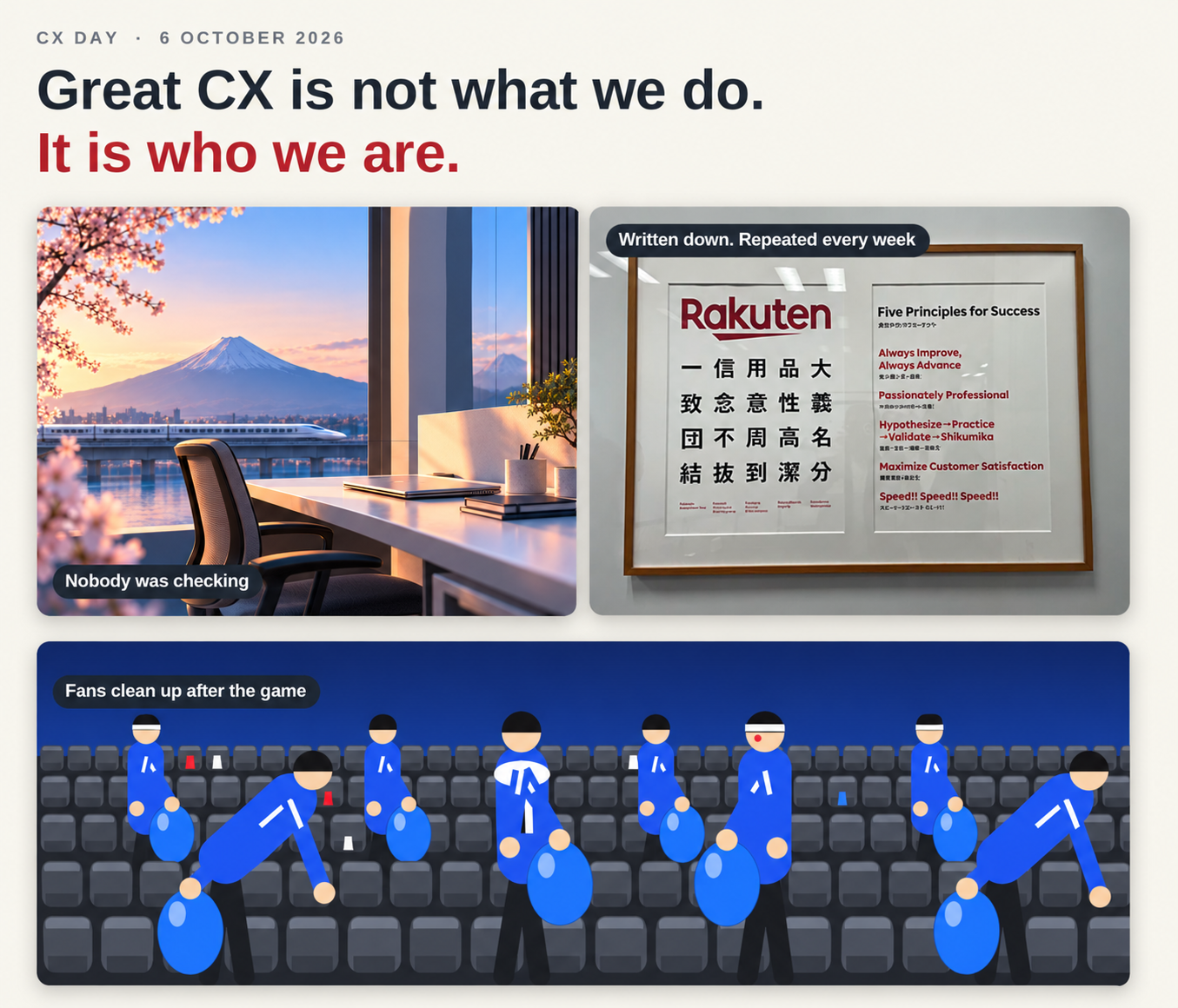
Think about how we feel about Japanese products and services. Would you call it great CX, or would you call it identity? I would call it identity. It shows in the way fans clean up after themselves at a soccer stadium, and in the way every small detail is thought through before anyone sees it.
And here is what struck me most. Japan is still behind on digital in many areas. Buying a Shinkansen ticket can mean a queue of 20 to 30 minutes. Yet I leave overawed every time. The reliability, the consistency and the quiet focus on getting every small thing right outweigh the inconvenience. Customers do not remember our features. They remember how reliably we care.
The same is true of the companies we admire most. Apple did not start with a CX programme. It decided who it was, and the product followed. Steve Jobs obsessed over the simplest choices, what to include, what to leave out, every button that did not need to exist. Everything around the product connects seamlessly to everything else. The experience is not a department. It is the way the company thinks.
Zappos did something similar with culture. It built the company around the customer, and the experience became a result rather than a project. Once the identity is right, a great deal falls into place.
So what does it take? I believe it starts at the top. The CEO has to own it, define it, and repeat it until it becomes instinct.
Rakuten shows what that looks like. The company has written down who it is, in what it calls Rakuten Shugi, built around five principles for success. But the document is not the point. The rhythm is. Every week, its founder and CEO hosts a call to share the latest trends and insights from the various business units, and every week he takes one of the five principles and brings everyone back to it. Not once a year at an offsite. Every week.
That is how a philosophy on a web page becomes a way of behaving.
Measurement still matters. Scores and surveys tell us how far we have travelled and whether we are doing it right. But they are a compass, not the destination. They cannot create an identity. They can only tell us whether we are living it.
This is hard, and that is the point. Identity costs something. It means doing the unglamorous thing when no one is watching, again and again. It means cleaning up after the game. It means leaving the desk clear at the end of the day.
We are still learning this as a company, and we do not have it figured out. So here is a question for CX Day.
If your customers could see how you behave when no one is looking, what would they say you are?
We would love to hear your thoughts.

.svg)






.svg)
