Twimbit X
One week to go: Live Webinar - 7 technology pivots and a disruptive market force in 2027
October 29, 2026


Join 6000+ industry executives who trust us.
Join 6000+ industry executives who trust us.

Varnika Goel


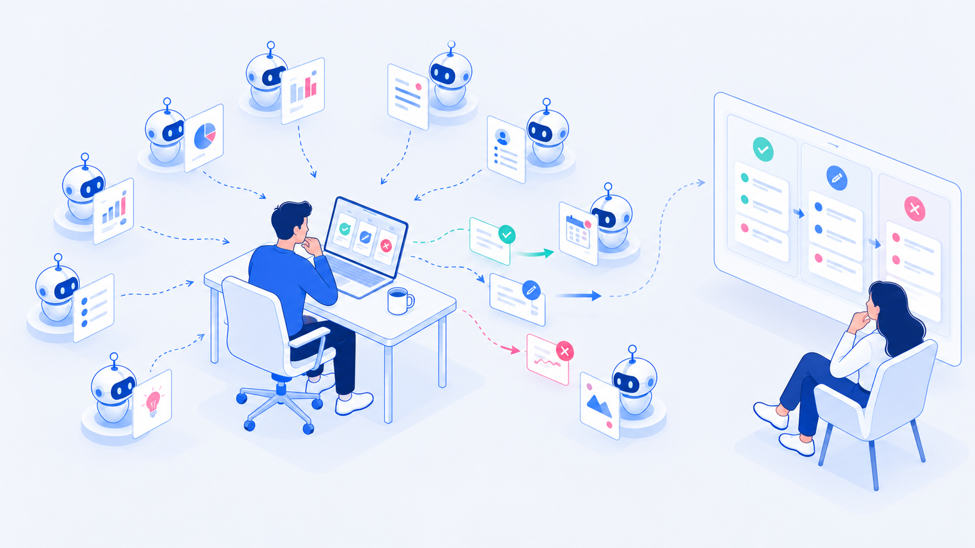
AI is making individual people faster. A company gets faster when that speed carries through every step between them.

A sales rep drafts a proposal in an hour with AI and then waits two days for approval, so most of the speed is lost before the proposal reaches the buyer. The same pattern runs through campaign briefs, client reports, and onboarding plans, anywhere work passes from one person to the next.
The companies that report results at scale have reworked the whole process around the AI step. The gains they describe come from changing how a request moves from start to finish.
Salesforce says that after its first year, its help-site agent had handled more than 1.5 million support requests, the majority of cases without humans. IBM reworked its HR, IT support, procurement, and finance workflows, with a goal of releasing early working versions of its AI tools roughly every two weeks. It reports $4.5 billion in productivity gains over three years.
That kind of rework starts with knowing where the speed stalls.
Following that proposal from request to approval shows the saved hour disappearing in three places.
The first stall is the wait, with the proposal sitting in an approval queue while the next person finishes something else.
A second stall comes in the translation, since the buyer’s priorities came out in the discovery call and little of that reaches the proposal, which leaves the person writing it to start from a summary.
The third sits with the owner, since one rep can build a strong way of working while no one is responsible for spreading it, so the rest of the team never hears about it.
Because none of this shows up on a single desk, individual speed can look healthy while the proposal still takes days.
Four moves turn one fast desk into a fast company, and the proposal is a good place to start:
So, how long does a proposal take on your team, and where does it wait?
With Twimbit X, we build tools that help teams expand what they're capable of, not just how fast they move. The goal is to expand what your team can credibly handle. If this sparked an idea, let’s explore it together. Reach out to see how Twimbit X can help your team raise its own ceiling.
Book a call