.svg)

Twimbit X
You Can’t Delegate Understanding
May 14, 2026

.svg)
.svg)


Join 6000+ industry executives who trust us.
Join 6000+ industry executives who trust us.

William Kiong Wai Lun


A wave of AI-cited layoffs is making headlines. But the structural shift underneath started long before any of these announcements.
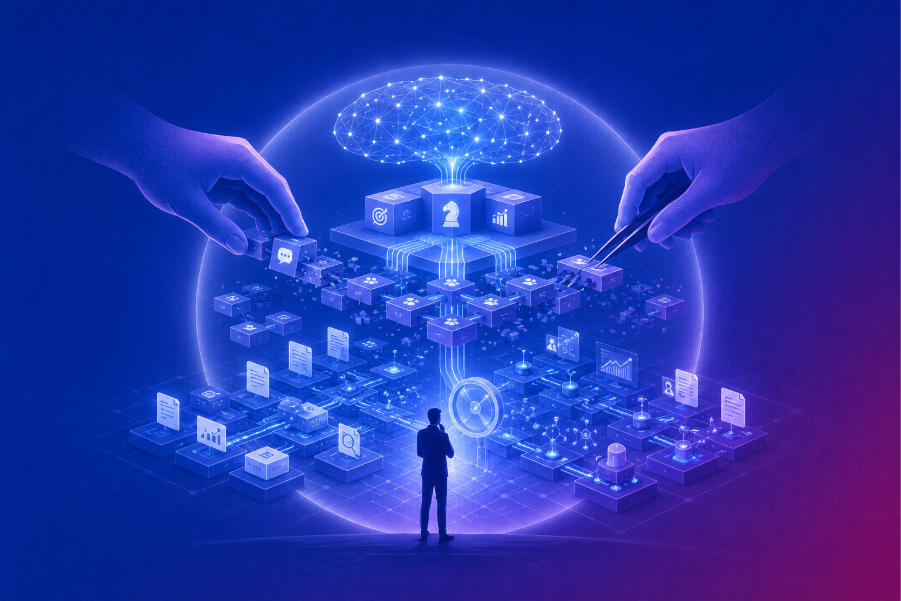
Coinbase cut 14% of its workforce this month. Cloudflare followed with 20% of its headcount. Duolingo, Salesforce, and others have made similar moves over the past year. Every CEO memo uses language that sounds nearly identical: AI-native, leaner, built for what's next.
Brian Armstrong, CEO of Coinbase, named what was being cut: “pure managers.” People whose primary function was to coordinate, relay, and translate between the people who built things and the people who decided things. These roles grew for a reason — understanding didn't scale, so organisations created a layer to move it around. Someone held the context, kept the stakeholders aligned, and carried knowledge from one room to the next.
AI just made the bridge redundant.
Andrej Karpathy, co-founder of OpenAI and former head of AI at Tesla, is one of the most technically credible voices working in this field. At Sequoia's AI Ascent 2026, he articulated something the layoff announcements are starting to make visible.
For years, execution was the transferable part of any job. AI tools, specifically the autonomous systems now handling writing, research, analysis, and coordination across workflows, have made that transfer complete. What becomes less scarce by the day is code generation, first drafts, and repetitive tasks. Understanding, taste, judgment, and knowing when the model is confidently incorrect are becoming everything.
Karpathy draws the line precisely: you can outsource your thinking, but you can't outsource your understanding. Even as agents handle more of the work, the human still needs to know what is worth building, what question matters, what result looks suspicious, and what trade-off is acceptable.
The professional who understands their domain deeply enough to interrogate what comes back will always outperform the one who forwards it.
Execution scales. Judgment doesn't. At least not yet.
So what does it mean to build a team that AI makes stronger, not smaller?
Understanding is what compounds. Here are three ways to build it:
Get closer to the output. Before any AI-generated brief, summary, or analysis moves forward, ask what it missed and what assumption is baked in that shouldn't be. Teams that build this habit develop sharper instincts over time.
Use AI to go deeper into your domain, not around it. The highest-leverage use of these tools is research, synthesis, and preparation — surfacing what you didn't know about a prospect, a market, or a customer. Bring your own judgment to what it means.
Build the skill of writing good specs. Directing these tools well requires knowing your domain clearly enough to articulate what good looks like: what the output should contain, what to avoid, what the standard is. Precision in the brief reflects depth in the domain.
The depth you build now is what determines which side of the restructuring your team sits on.
With Twimbit X, we build tools that help teams expand what they're capable of, not just how fast they move. The goal is to expand what your team can credibly handle. If this sparked an idea, let’s explore it together. Reach out to see how Twimbit X can help your team raise its own ceiling.
Book a call





.svg)

.svg)
